A paper capacitor stores its charge between two metal foils separated by impregnated capacitor paper. It was the default general purpose capacitor for most of the twentieth century, and it has almost vanished from new designs, pushed out by polyester and polypropylene film parts that are smaller, more stable and cheaper to build. Knowing why it lost its place is what tells you where paper still makes sense and where it does not.
How a Paper Capacitor Is Built
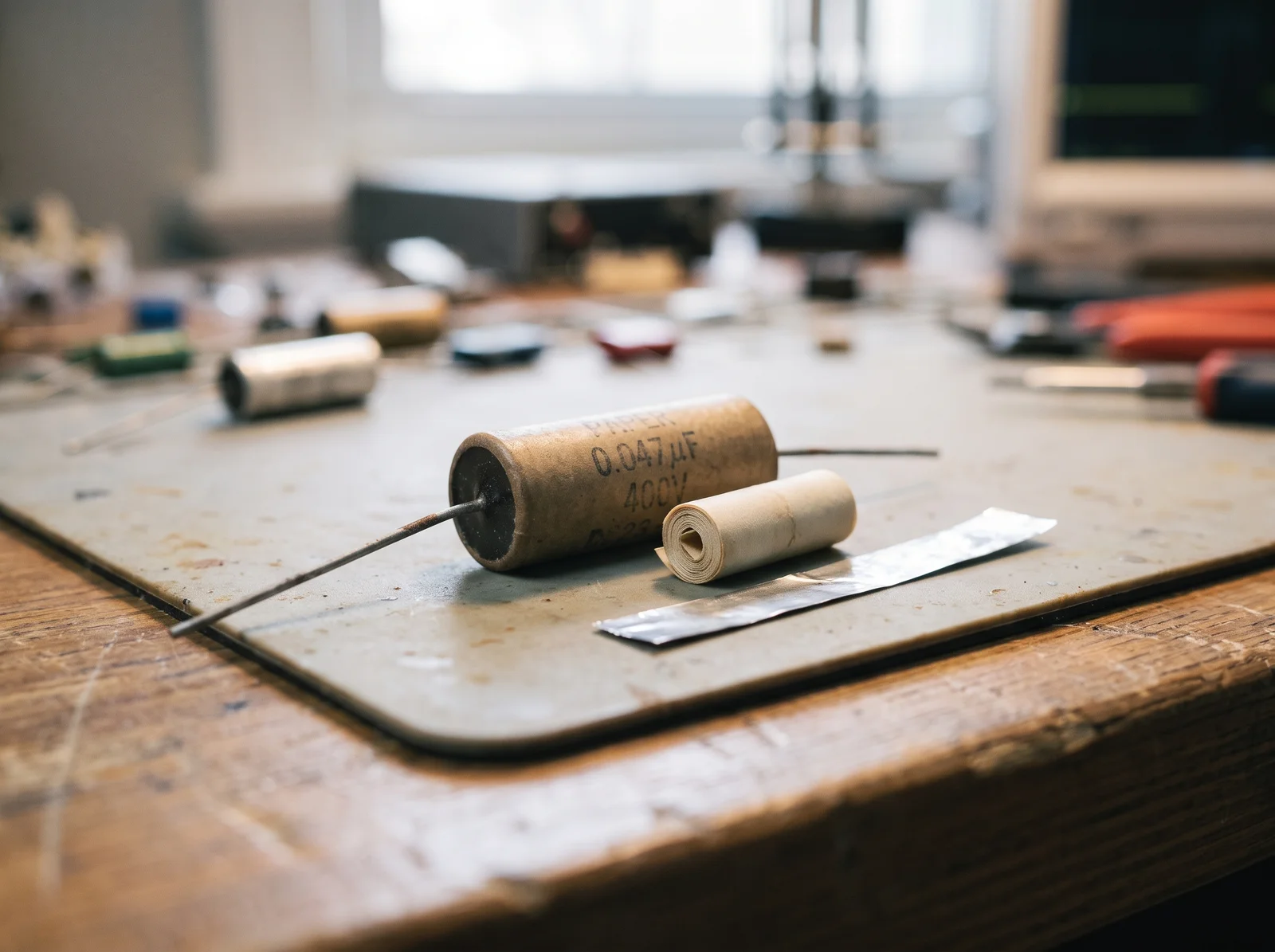
The classic construction is a sandwich. Two strips of aluminium or tin foil are separated by capacitor paper, and the stack is wound into a cylinder. The paper is only 6 to 20 µm thick, which is what gives these capacitors their high capacitance in a modest case. After winding, the roll is impregnated with oil or wax to raise the dielectric strength and keep moisture out, leads are attached, and the body is either housed in a plastic shell or potted in epoxy.
A later variant changed the electrode. Instead of separate foil, the paper itself is vacuum coated with a metal layer, usually zinc or aluminium around 0.1 µm thick, and then wound. This is the metallized paper capacitor, and it behaves differently from the foil type because the electrode can be destroyed locally without destroying the capacitor, a property covered further down.
One detail from the foil era is worth keeping in mind when you see an old capacitor marked as paper. Because paper is porous and contains weak spots, professional metallized paper designs use at least two layers of paper, so that a defect in one layer is unlikely to line up with a defect in the next. Plastic film, which has far fewer defects, needs only one layer. That difference alone explains much of why paper lost.
What Paper Offers, and What It Costs
The thin dielectric is the whole argument in favour of paper: 6 to 20 µm of insulation means capacitance values reaching 1 to 20 µF with a high working voltage, using a simple and cheap winding process.
The costs are all on the stability side.
- Dielectric loss is high compared with plastic film, so these capacitors run warm in AC service.
- Paper is hygroscopic. It absorbs moisture and needs sealing, which makes it unsuitable for humid environments unless the case is sound.
- The dielectric ages. Chemical and thermal stability is poor, and capacitance drifts over years of service.
- Working temperature is typically limited to 85 °C to 100 °C.
- Loss and moisture together rule it out of high frequency circuits.
That combination leaves the foil paper capacitor useful for DC and low frequency work, which is exactly what it was used for, and nothing more demanding.
Why Plastic Film Replaced It
From around 1980, polyester (PET) film capacitors displaced paper and metallized paper almost completely in low power DC electronics. The reasons are concrete rather than a matter of fashion.
| Factor | Paper / metallized paper | Polyester film |
|---|---|---|
| Defect density | High, needs two paper layers | Low, single layer is enough |
| Size for the same rating | Larger | Distinctly smaller |
| Moisture uptake | High, sealing is critical | Very low |
| Long term stability | Drifts as the paper ages | Stable over decades |
| Manufacturing | Oil vacuum impregnation, leak prone cases | Simpler, less material, lower cost |
The polyester that took over is not a perfect dielectric either, and it is worth knowing its own numbers so you can judge whether it is the right replacement in a given spot. PET has a relative permittivity around 3.3 at 1 kHz, a dielectric strength near 580 V/µm in theory and roughly 280 V/µm as realised in production, and a working temperature up to 125 °C. Its capacitance moves about ±5% over its temperature range and falls around 3% from 100 Hz to 100 kHz. Where those numbers are not good enough, polypropylene is the next step up.
Where Metallized Paper Still Wins
Metallized paper did not disappear entirely, because it has one property that plastic film cannot match.
When a metallized capacitor breaks down, the thin metal around the fault vaporises and the insulation recovers. This is self healing, and every metallized film does it. What sets metallized paper apart is how little disturbance the process causes: with zinc metallization the voltage drop from a clearing event is on the order of −10 mV to −1 V. Cellulose also leaves uniquely low carbon deposits at the cleared site, which is why metallized paper saw a limited return in transient protection capacitors for mains applications.
The catch is that repeated clearing events generate gas inside the case, so a metallized paper capacitor needs rupture protection built in. That, and the cost of oil impregnation, keeps it in a narrow band of uses: radio frequency interference suppression capacitors, motor run capacitors, and mixed dielectric designs where paper is combined with polyester or polypropylene film in large AC and DC power capacitors.
Replacing a Paper Capacitor Today
If you are substituting for an old paper part, the target depends on what the circuit is doing.
| Original duty | Modern replacement |
|---|---|
| DC filtering and coupling | Polyester film, such as a CL21 metallized polyester part |
| High frequency or higher power | Polypropylene film |
| Across the mains, interference suppression | Class X2 safety film capacitor |
| Motor run | Polypropylene or mixed dielectric motor capacitor |
| Precision timing | Polyphenylene sulphide (PPS) film |
Xuansn produces the film capacitors that replaced paper in general purpose roles. Our film capacitor range covers polyester and polypropylene types, and the polyester capacitors section lists the CL21 style parts used for DC filtering and coupling.
FAQ
Are paper capacitors still manufactured?
Foil paper capacitors are effectively gone from general electronics. Metallized paper is still made in small volumes for interference suppression, motor run duty and large power capacitors where it is used as a mixed dielectric alongside plastic film.
Why do paper capacitors fail?
Moisture is the usual cause. Paper absorbs water, and once the seal fails the dielectric strength drops and the capacitor short circuits. Ageing of the dielectric compound and thermal stress accelerate the process.
Can I swap a paper capacitor for a ceramic one?
Only if the capacitance is small. Paper capacitors are typically in the microfarad range, well beyond what a ceramic part offers at the same voltage and size. A polyester film capacitor is the closer match in both value and behaviour.
If you are replacing a paper capacitor in a legacy design and need the value, voltage and case size matched, send the details to [email protected], or contact us here with the specification, and we will suggest a film part that fits the same footprint.