What Are the Main Types of Capacitors?
Capacitors are fundamental passive components found in nearly every electronic device. They store energy in an electric field and release it when needed. Choosing the right type is one of the most important decisions in circuit design, because each capacitor technology has different strengths: capacitance density, voltage, ESR, frequency behavior, lifetime and cost.
This guide explains the main capacitor types, how each works, where each is best used, and how to choose between them. As a full-range capacitor manufacturer, Xuansn produces most of the types covered here.
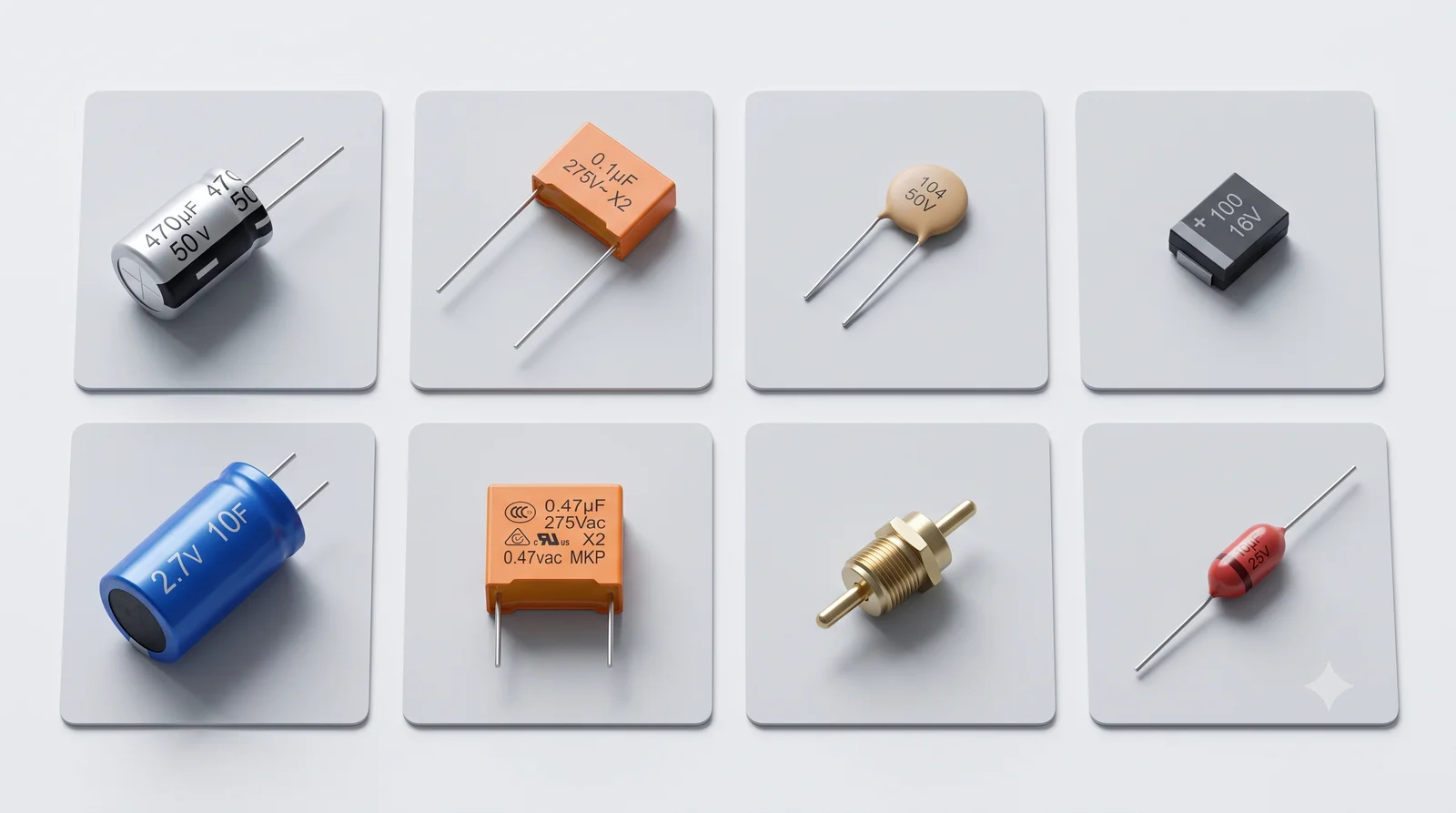
Electrolytic Capacitors
Electrolytic capacitors offer the highest capacitance per volume. They are polarized (must be connected with correct polarity) and use an oxide film dielectric with a liquid or solid electrolyte. The main sub-type is aluminum electrolytic, available in radial, snap-in, screw and SMD forms.
- Best for: power supply filtering, DC-link smoothing, energy buffering
- Strengths: high capacitance, low cost, high voltage
- Limits: polarized, limited lifetime, poor high-frequency behavior
Film Capacitors
Film capacitors use a thin plastic film dielectric. They are non-polarized, self-healing, and extremely stable, with very low loss and long life. Dielectrics include polypropylene and polyester, in series such as CBB, CL and X2.
- Best for: motor run, EMI suppression, DC-link in inverters, snubber, high-frequency circuits
- Strengths: low ESR, high voltage, long life, high-frequency performance
- Limits: lower capacitance density than electrolytic
Related: Film capacitor range
Ceramic Capacitors
Ceramic capacitors use a ceramic dielectric. They are small, cheap and non-polarized, available from tiny pF values to tens of µF. MLCC (multilayer ceramic capacitors) dominate modern surface-mount electronics.
- Best for: decoupling, bypass, high-frequency filtering, timing
- Strengths: tiny size, low cost, good high-frequency behavior
- Limits: capacitance varies with DC bias and temperature (Class II)
Related: Ceramic capacitor range
Solid / Polymer Capacitors
Solid (polymer) capacitors replace the liquid electrolyte with a conductive polymer. They combine the high capacitance of electrolytic capacitors with very low ESR and longer life, at the cost of lower voltage ratings.
- Best for: CPU/GPU power delivery, DC-DC converters, high-ripple applications
- Strengths: low ESR, stable over temperature, long life, no drying out
- Limits: lower voltage, higher cost
Related: Solid capacitor range
Supercapacitors
Supercapacitors store energy electrostatically in an electric double layer. They offer enormous power density, millions of cycles, and work at low temperatures, bridging the gap between batteries and conventional capacitors.
- Best for: engine starting, UPS hold-up, energy recovery, backup power
- Strengths: fast charge, huge cycle life, works at -40°C
- Limits: low voltage per cell (2.5-3.8V), lower energy density than batteries
Related: Supercapacitor range
Safety Capacitors (X and Y)
Safety capacitors are certified for AC mains EMI suppression. X capacitors connect across the line; Y capacitors connect line-to-ground. They are rated to fail safely and certified to EN/IEC 60384-14.
- Best for: EMC filtering in any AC mains-powered equipment
- Strengths: safety certification, reliable failure mode
Related: Safety capacitor range
Feedthrough Capacitors
Feedthrough capacitors pass a line through a shield wall while filtering high-frequency noise, with very low parasitic inductance.
- Best for: EMI filtering at enclosure boundaries, telecom, military, medical
Related: Feedthrough capacitor range
Capacitor Type Comparison
| Type | Polarized | Capacitance | Voltage | Best Use |
|---|---|---|---|---|
| Electrolytic | Yes | Very high | Medium-high | Power filtering |
| Film | No | Medium | High | AC, high-frequency, power |
| Ceramic | No | Low-medium | Medium | Decoupling, bypass |
| Solid/Polymer | Yes | High | Low-medium | Low-ESR DC power |
| Supercapacitor | Yes | Farads | Low (2.5-3.8V) | Power bursts, backup |
| Safety X/Y | No | Low-medium | AC mains | EMI suppression |
How to Choose the Right Capacitor
- Determine the function: filtering, decoupling, timing, energy storage, or EMI suppression.
- Set capacitance and voltage with derating margin.
- Check ESR/ESL for ripple and high-frequency requirements.
- Consider lifetime and operating temperature.
- Choose the mounting: radial, snap-in, screw, SMD, or through-wall.
- Confirm polarity requirements (electrolytic and supercapacitor are polarized).
Select from radial, snap-in, SMD and screw types to match your assembly.
FAQ
Q: Which capacitor type is best for power supplies?
A: Aluminum electrolytic for bulk energy, solid/polymer for low-ESR rails, ceramic for high-frequency decoupling. Most power supplies use all three.
Q: Are all capacitors polarized?
A: No. Electrolytic, solid and supercapacitors are polarized. Film, ceramic and safety capacitors are not.
Q: What does capacitor type matter for lifespan?
A: Electrolytics dry out over time; film, ceramic and solid types last far longer. Choose based on the application lifetime target.
Q: Can I use one type everywhere?
A: No. Each type fills a different role; the best designs use a mix matched to each circuit function.
Need Help Choosing the Right Capacitor?
Xuansn Capacitor manufactures aluminum electrolytic, film, ceramic, solid, supercapacitor, safety and feedthrough capacitors. Our engineers can help you select the right type and series for your application.
Contact us with your requirements and we will recommend a solution within 24 hours.