Capacitor supply problems are rarely created by the purchasing team. They are created on the schematic, months or years before anyone needs a second source. A part that looks interchangeable on paper can still turn out to be impossible to replace. The reasons are mundane: a footprint only one factory builds, a tolerance window drawn at the edge of what the industry can hold, or a safety certificate that names a single manufacturer.
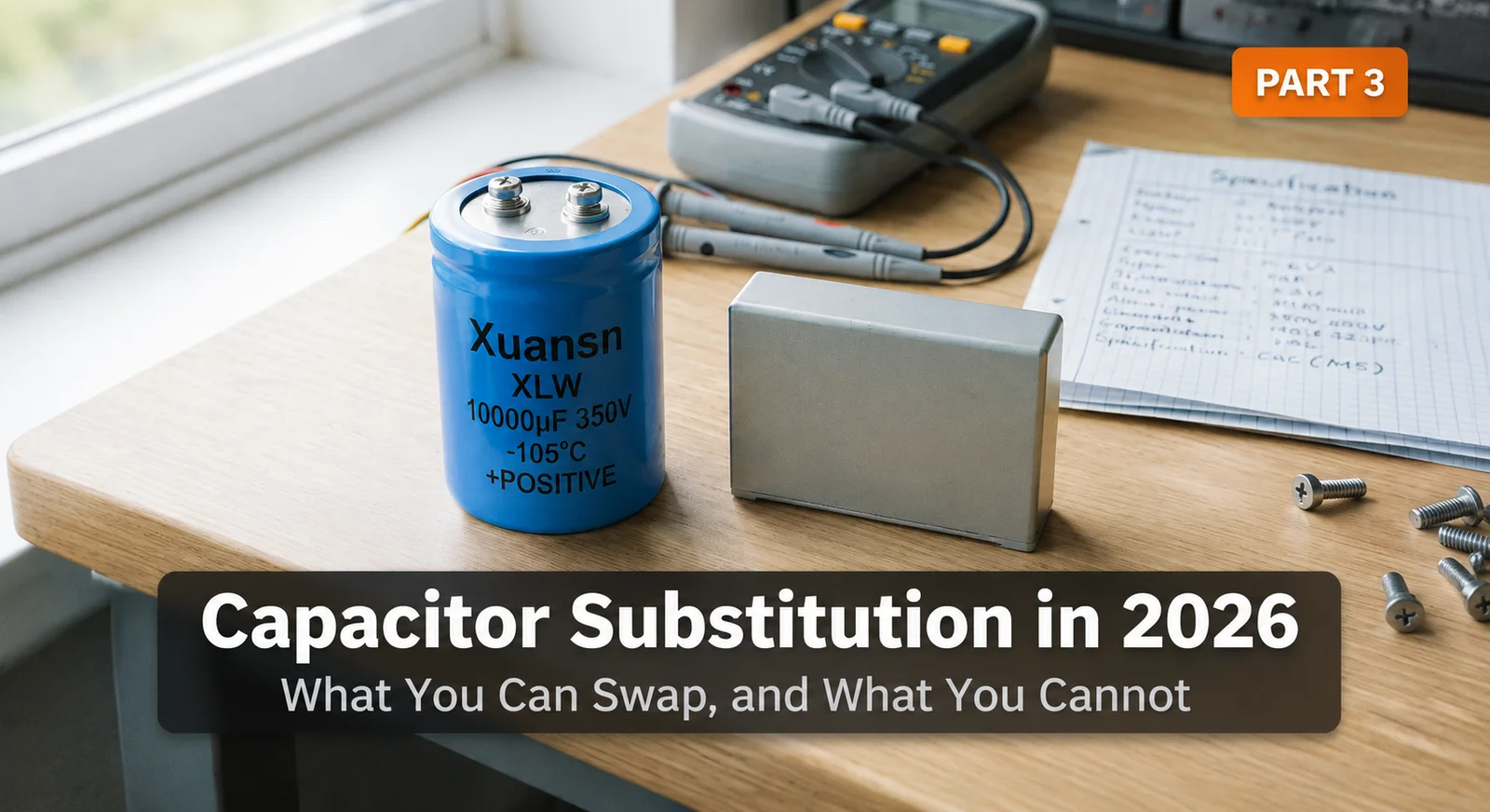
This article closes our 2026 sourcing series, which started with why capacitor prices rose, moved through locking in supply before allocation, and then looked at what can and cannot be substituted. Those three were about what a buyer can do once the shortage arrives. This one sits earlier: what has to be true in the design file for sourcing to stay possible two years from now.
Three Things Decide Whether a Capacitor Can Be Replaced
By the time a distributor sends an allocation notice, the answer is usually already fixed. Three constraints decide it, and all three are set at design review.
| Constraint | How the design locks it in | What unlocking costs |
|---|---|---|
| Mechanical interface | Footprint, lead pitch, terminal type and can diameter are drawn around one maker’s range | A board revision, new stencil and a fresh layout and thermal check |
| Parameter window | The specification is written at the limit of what the industry delivers, for ESR, tolerance, temperature or ripple | Requalification, and sometimes a performance compromise |
| Compliance status | Safety and automotive approvals name a manufacturer and a part, not a parameter set | A new certificate and a new customer approval, measured in weeks to months |
The three are not equal. Any of them can block a swap on its own, and the mechanical one is the most expensive to undo after the fact.
Footprint Is the Lock That Rewrites the Board
Lead pitch is the easiest detail to get wrong. Radial lead electrolytic capacitors come with 5.0 mm or 7.5 mm lead spacing, and the two do not share a hole pattern. A board laid out for 5.0 mm can still take a 7.5 mm part if someone bends the leads, but on an automated insertion line that is a different process, not a different part. On a hand-built prototype nobody notices, which is exactly why the problem survives to production.
Snap-in parts have their own version of the same trap. The lead pitch is normally 10 mm, with two leads on smaller diameters and four leads on cans from roughly 30 mm upward. Two leads and four leads are not interchangeable by drilling two more holes, since the landing pattern and the mechanical anchoring differ. Screw-terminal capacitors add another layer: the stud is M5 or M6 depending on the series, and even two cans of the same nominal size can have different stud spacing and terminal shapes between makers.
Designing for a replaceable part does not mean designing for every part. It means writing constraints that more than one maker can meet:
- Give the specification a maximum diameter and height with a margin, for example 5 percent on diameter and 3 mm on height, instead of a fixed case code.
- Keep a standard lead pitch unless the space genuinely cannot take it.
- State the terminal form (two-lead snap-in, four-lead snap-in, M5 screw) as a requirement, and check which approved makers offer something in that form.
A footprint with a small margin costs nothing at layout time and is very hard to add later.
The Parameter Window You Write Becomes Your Supplier List
An ESR limit is the most common self-inflicted constraint. If comparable parts on the market sit at 25 to 30 mΩ and the specification asks for a maximum of 20 mΩ, the supplier list drops from a dozen manufacturers to one or two, and those two know it. In practice the limit is rarely deliberate. It usually comes from copying the specification of a part that was already difficult to source, and the restriction is inherited several designs later. The same happens with tolerance. Write ±10 percent where ±20 percent would work, and a large part of the industry is excluded before the first enquiry goes out.
Derating buys flexibility as a side effect. A 48 V rail can run on a 63 V part at roughly 1.3 times derating, or on a 100 V part at just over 2 times. The second option opens a much wider group of suppliers. Derating is chosen for life and reliability in the first place, and the supply benefit comes along with it.
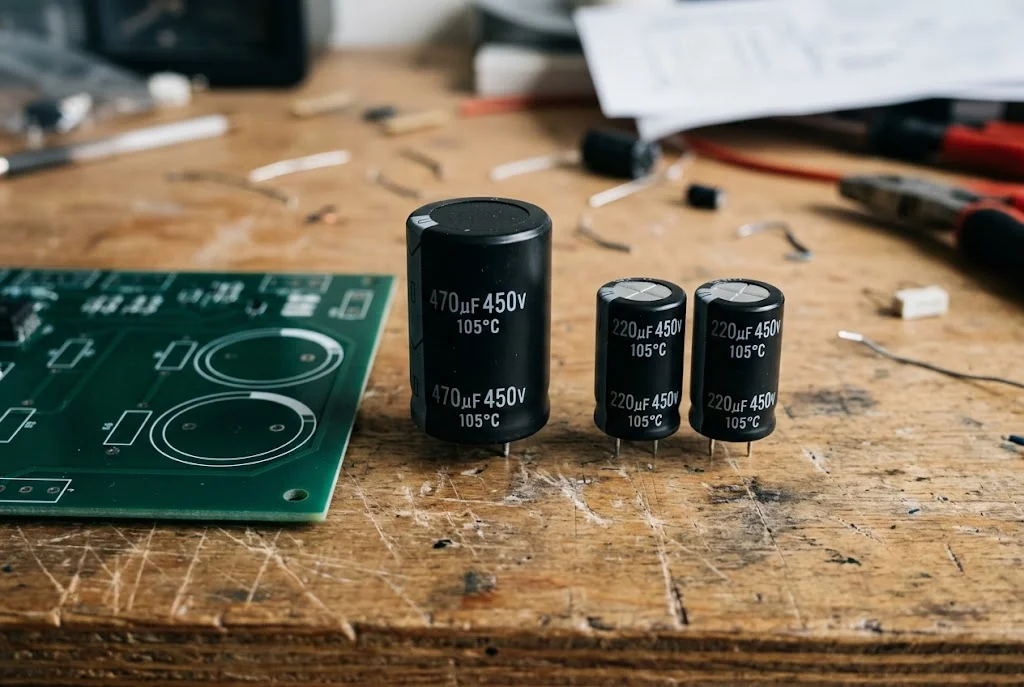
The capacitance and voltage combination decides how scarce the part is. A 470 µF 450 V snap-in is a hard combination to source from many makers at once. The same bus can sometimes run on two 220 µF 450 V parts in parallel, or on a lower capacitance if the ripple budget allows. Both routes widen the supplier list immediately. They need board space and a current-sharing check, so they have to be considered while the layout is still open.
Certification and the Approved Vendor List
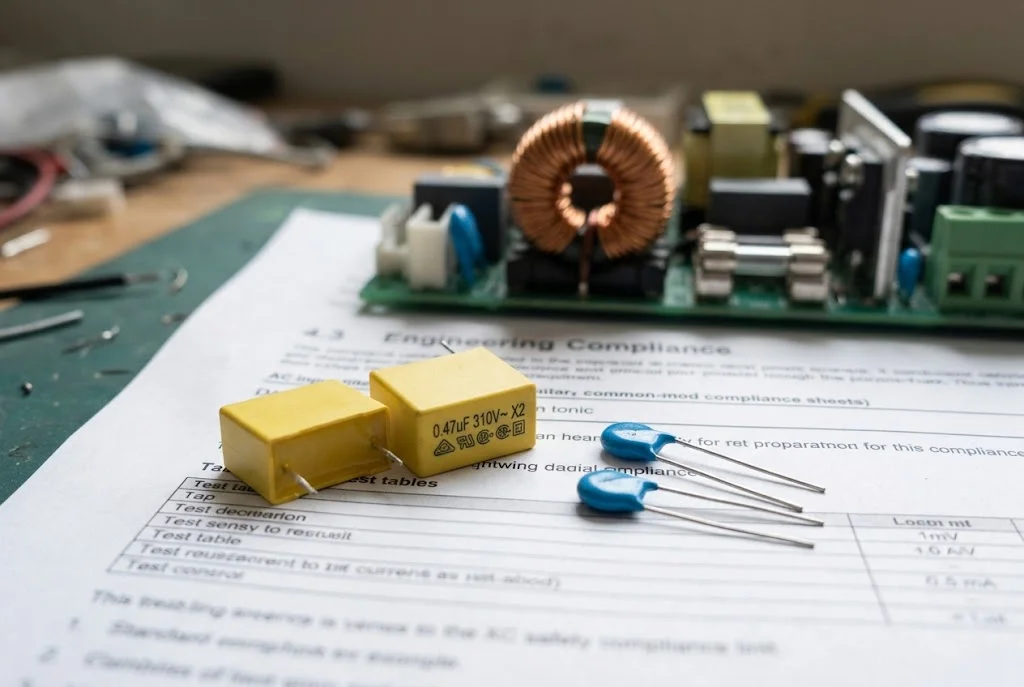
Safety capacitors show the problem most clearly. X and Y class parts are certified to IEC 60384-14, or its EN and UL equivalents, and the certificate is issued to a specific manufacturer’s part rather than to a set of parameters. Two capacitors can match on capacitance, voltage and dimensions and still not be interchangeable, because the second one carries no certificate. Changing maker means a new certification, which is measured in weeks rather than days.
Automotive adds a second layer on top: AEC-Q200 validation plus the customer’s production part approval process, followed by whatever the customer’s approved vendor list requires. None of this is avoidable, and none of it can be shortcut once a shortage is already running.
The practical response is to treat certification as a design-stage task. Where a position depends on a safety or automotive approval, the goal is two named, certified makers in the release documentation, not one maker and an intention to find another.
Writing a Specification That Leaves Room
The difference between a replaceable part and a locked one is often just how the requirement is phrased. A specification that names a parameter set with an interface and a compliance level can be met by several factories. One that names a competitor’s part number can be met by one.
A workable shape for a bulk capacitor requirement looks like this:
- Capacitance: 470 µF ±20 percent
- Voltage: 450 V, applied at or below 80 percent of rated in normal operation
- ESR: 35 mΩ maximum at 100 Hz, 20 °C
- Ripple current: 2.5 A minimum at 105 °C, 100 Hz
- Case: snap-in, 10 mm lead pitch, maximum 35 mm diameter by 50 mm height
- Compliance: EN 60384-14 X2 where the position requires it, two approved manufacturers
Nothing in that list is loose. Every line is a real requirement, and a qualified engineer can still compare parts across makers with it. That is the point: a specification built from parameters gives the buyer something to negotiate with, while a specification built from a part number gives the maker all of the leverage.
What to Ask Before the Design Review Sign-Off
These questions are worth asking while changes are still cheap:
- If this line is allocated until the second quarter of next year, what is the board allowed to change?
- Which positions already have a second, certified manufacturer? Named parts, not options that could be explored.
- Where is the specification drawn tighter than the industry norm, in ESR, tolerance, temperature or ripple?
- Does any footprint accept only one maker’s case size?
- How much free space is left around each capacitor, in diameter and height?
- Can this position be split into two smaller parts without hurting the electrical behaviour?
- Which certificates bind a part to a single manufacturer?
- What does the customer’s approved vendor list allow today?
A design that answers these before release does not need a second source during a shortage. It already has one.

Where Flexibility Is Not Worth Paying For
Not every position should be widened for sourcing. High-frequency and timing circuits are the clearest case, because capacitance and ESR feed directly into how the circuit behaves, and a substitute that measures close on a bench can still shift performance in the field. Snubber and resonant positions sit in the same group. Very small portable designs run out of space before they run out of supplier options.
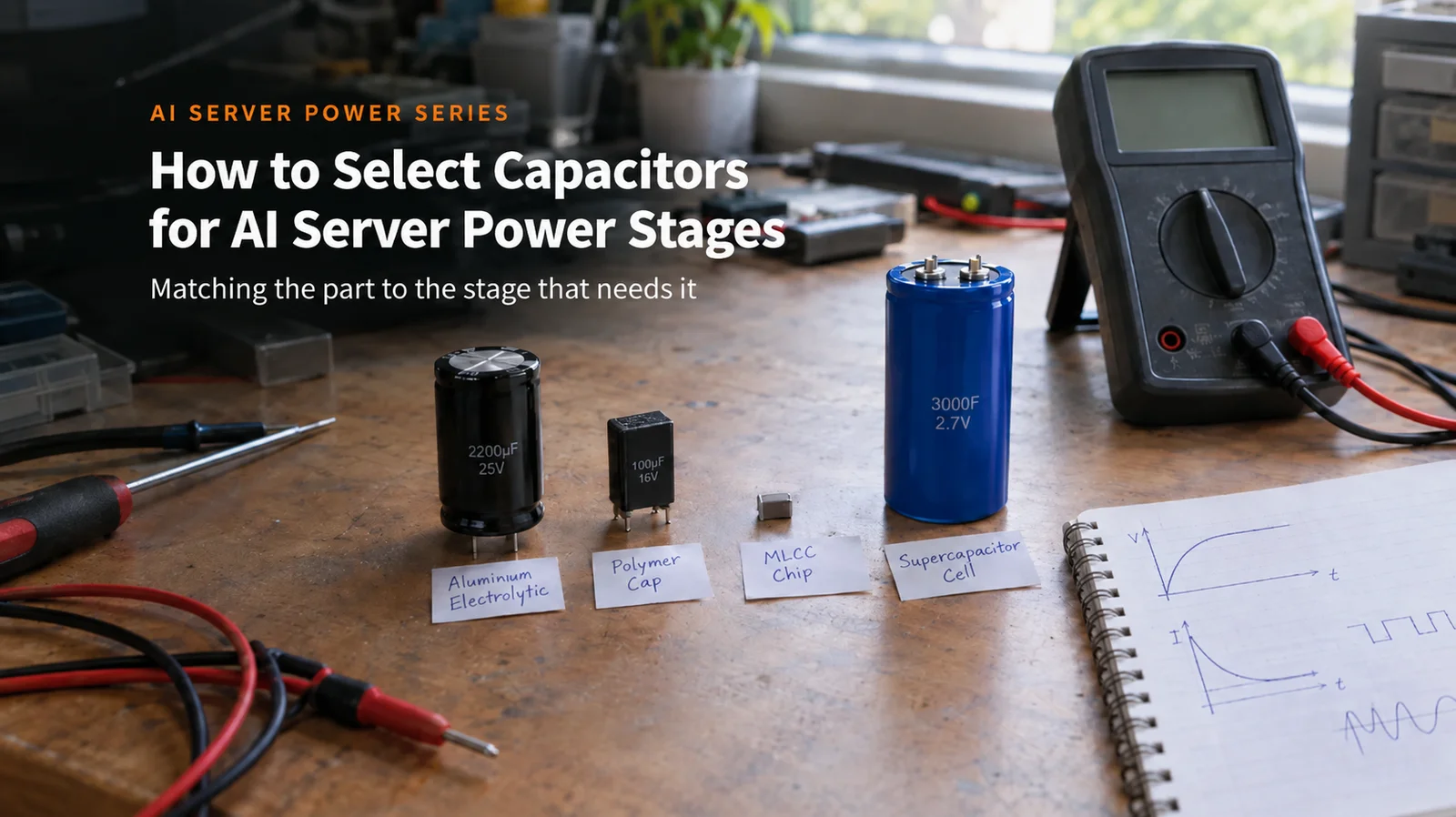
For those positions the practical move is different. Instead of loosening the specification, qualify a second maker against the tight one and put a part through validation before it is needed. Most filtering, energy storage and bulk decoupling positions have more room than designers assume, and family choices often do as well: once the electrical role is fixed, several capacitor types can usually cover it, and our guide to capacitor types sets out where each one fits. The effort belongs there first.
The Part of the Problem the Buyer Cannot Fix
A price cycle, a lead-time chart and a substitution table all assume the same thing: that the design has room to move. Where it does not, none of it helps. The constraints that decide how much room exists are set long before a buyer sees a shortage, and they sit in the design file rather than in the purchase order. Those constraints are the half of sourcing that no amount of negotiation can reach.
Questions About Capacitor Second Sourcing
Can a second source share the same safety certificate?
No. Certificates for X and Y class capacitors are issued to a specific manufacturer’s part, so a second maker needs its own certificate even when the parameters match. Plan the certification lead time into the schedule, not just the sample lead time.
How much extra board space does this actually cost?
Very little in most cases. The cost sits in the constraints rather than in extra parts: a diameter and height margin, a standard lead pitch, a specification that is not drawn at the industry limit. Where a capacitance and voltage combination is genuinely scarce, splitting it into two parallel parts is the option that widens supply, and that one does need space on the board.
We are already in production. Is it too late?
Not too late, but the work is different. Rank the lines by risk, looking at single-sourced positions, long lead times and specifications that are difficult to meet, then start with the top two or three. For those, qualifying a second maker against the existing board is usually faster than redrawing the part.
Do I add a second part number, or a second maker for the same part?
Both approaches are used. A second maker for the same specification leaves the board untouched and is the cheaper route. A second part number, such as a different case size or capacitance, needs layout space and its own qualification, and it is the fallback when the original combination cannot be sourced elsewhere.
Building a capacitor specification that has to survive the next allocation cycle? Send us the parameters and the position the capacitor sits in. Our engineers will come back with the parts we can hold to that window, and with the second sources worth listing beside them. Xuansn Capacitor manufactures aluminum electrolytic, film and supercapacitor parts.
✉ [email protected] | ☎ +86-769-8166 8821 | Send your specification