uF (microfarad) is a unit of capacitance that indicates how much electrical charge a capacitor can store. When asking what does uF mean on a capacitor, it simply refers to the capacitor’s ability to store and release electrical energy.
It is one of the most common markings found on capacitors, alongside values like nF, pF, and MFD. If you’ve ever seen labels such as 10uF, 100uF, or MFD, understanding these markings is essential for selecting the right component and ensuring proper circuit performance.
What Is uF in a Capacitor?
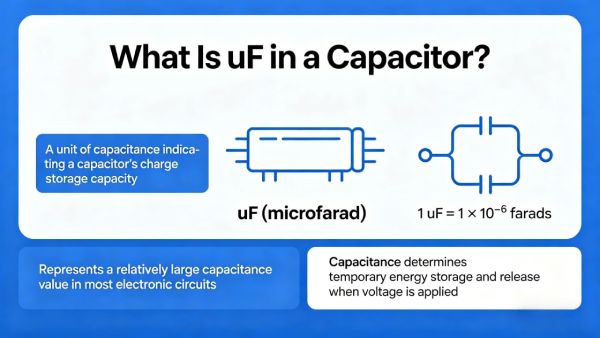
uF (microfarad) is a unit of capacitance that indicates how much electrical charge a capacitor can store.
In simple terms, if you are asking what is uF in a capacitor, it refers to the capacitor’s ability to store and release electrical energy.
- 1 uF (microfarad) = 1 × 10⁻⁶ farads
It represents a relatively large capacitance value in most electronic circuits
Capacitance determines how much energy a capacitor can temporarily store and release when voltage is applied.
Why uF Is Important in Capacitors
Understanding what is uF in capacitor is important because the capacitance value directly affects circuit performance.
A capacitor’s uF value influences:
- Power supply filtering → stabilizes voltage and reduces ripple
- Energy storage → provides short bursts of current when needed
- Signal smoothing → reduces noise and improves signal quality
👉 In general:
Higher uF values provide stronger filtering and energy storage capability.
Capacitor Unit Conversion (uF, nF, pF)
Capacitors use different units depending on their capacitance value. Understanding capacitor unit conversion is essential when selecting or replacing components in electronic circuits.
Capacitance Units Explained
The three most common units are:
| Unit | Full Name | Value |
|---|---|---|
| uF | microfarad | 10⁻⁶ F |
| nF | nanofarad | 10⁻⁹ F |
| pF | picofarad | 10⁻¹² F |
👉 In simple terms:
uF > nF > pF, with each step differing by a factor of 1000.
uF vs nF vs pF Conversion
1 μF = 10³ nF = 10⁶ pF
This means:
- 1 uF = 1000 nF
- 1 nF = 1000 pF
- 1 uF = 1,000,000 pF
👉 This relationship is commonly searched as uf nf pf conversion.
Practical Conversion Examples
Here are some real-world examples to help you understand:
- 0.1uF = 100nF = 100,000pF
- 1nF = 0.001uF
- 470pF = 0.47nF
These conversions are frequently used when reading datasheets or replacing capacitors.
Capacitor Value Chart (Quick Reference)
Engineers often rely on a capacitor value chart to quickly convert and compare values across different units.
For example:
| uF | nF | pF |
|---|---|---|
| 1uF | 1000nF | 1000,000pF |
| 0.1uF | 100nF | 100,000nF |
| 0.01uF | 10nF | 10,000nF |
👉 Using a capacitor value chart can reduce errors and speed up component selection.
What Does MFD Mean on a Capacitor?
If you come across the marking MFD on a capacitor, especially in older equipment, you might wonder: what does MFD mean?
👉 MFD stands for microfarad, which is the same unit as uF.
In other words:
1 MFD = 1 uF (microfarad)
There is no difference in value, only a difference in labeling style.
Why Do Some Capacitors Use MFD?
The term MFD comes from older manufacturing conventions.
In the past, the Greek symbol “µ” (micro) was not easy to print on components, so manufacturers used MFD as a replacement.
Today:
- uF is the modern standard
- MFD is mostly found in legacy systems
Where You’ll See MFD Markings
You are most likely to encounter MFD in:
- HVAC systems (air conditioners, compressors)
- Motor start/run capacitors
- Vintage electronic equipment
👉 Understanding what does MFD mean on a capacitor is important when replacing older components with modern equivalents.
MFD vs uF: Are They the Same?
| Marking | Meaning | Usage |
|---|---|---|
| uF | Microfarad | Modern electronics |
| MFD | Microfarad | Older equipment |
👉 Always treat MFD and uF as interchangeable units when selecting a capacitor.
How to Read Capacitor Values
Capacitor values indicate the capacitance, voltage rating, and tolerance of a capacitor, and understanding how to read capacitor values is essential for selecting the correct component and avoiding circuit errors.
Capacitor values are displayed using either direct markings or coded systems, depending on the size and type of the capacitor.
1. Direct Marking on Capacitors
Direct marking is the simplest way to read capacitor values, commonly found on larger capacitors such as electrolytic types.
Examples:
- 10uF 400V
- 100uF 50V
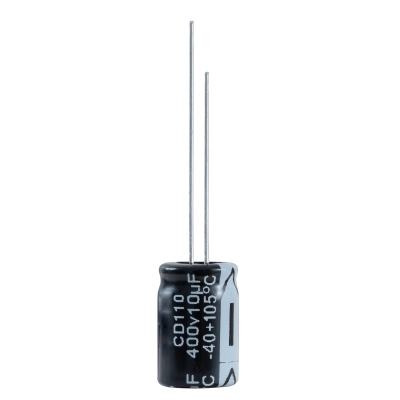
👉 Meaning:
uF (microfarad) = capacitance value
V (volts) = maximum voltage rating
Tip:
Always choose a capacitor with a voltage rating higher than the actual circuit voltage to ensure safe operation.
2. Capacitor Code Meaning (3-Digit System)
The 3-digit code system is a standard method used to represent capacitor values on small components, especially ceramic capacitors.
This is a key part of understanding capacitor code meaning.
Examples:
- 104 = 10 × 10⁴ pF = 100,000 pF = 100nF
- 103 = 10 × 10³ pF = 10nF
How the 3-Digit Code Works
- First two digits → significant figures
- Third digit → multiplier (number of zeros, in pF)
👉 This system is widely used in compact capacitors where space is limited.
3. Capacitor Markings Explained (Tolerance & Voltage)
Capacitor markings often include additional specifications beyond capacitance, which are critical for proper component selection.
Common markings include:
- Tolerance → ±5%, ±10%, ±20%
- Voltage rating → 16V, 25V, 50V
- Temperature characteristics → X7R, C0G
👉 These specifications are part of capacitor markings explained and directly impact performance and reliability.
4. Common Mistakes When Reading Capacitor Values
Misinterpreting capacitor values is a common issue for beginners and can lead to circuit failure.
Typical mistakes include:
- Confusing pF, nF, and uF units
- Misreading 3-digit capacitor codes
- Ignoring voltage ratings
- Assuming all capacitors are polarized
👉 Avoiding these mistakes improves circuit stability and component lifespan.
Quick Answer: How to Read Capacitor Values
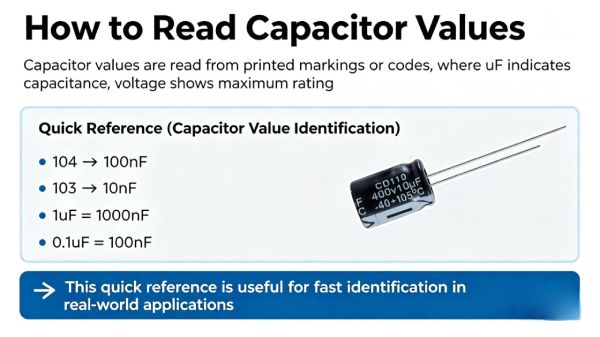
Capacitor values are read from printed markings or codes, where uF indicates capacitance, voltage shows maximum rating, and 3-digit codes represent values in pF.
Quick Reference (Capacitor Value Identification)
- 104 → 100nF
- 103 → 10nF
- 1uF = 1000nF
- 0.1uF = 100nF
👉 This quick reference is useful for fast identification in real-world applications.
Do Capacitors Have Polarity?
Some capacitors are polarized, while others are non-polarized.
- Electrolytic capacitors are polarized and must be connected correctly
- Ceramic and film capacitors are non-polarized and can be used in either direction
👉 Understanding capacitor polarity is important to avoid circuit damage.
For a detailed explanation, including how to identify positive and negative terminals, read our full guide on capacitor polarity.
Conclusion
Understanding what uF mean on a capacitor and how it relates to nF, pF, and MFD is essential for selecting the right component in any electronic circuit.
By mastering capacitor values, unit conversion, and markings, you can avoid common mistakes and ensure reliable circuit performance.
If you are working on high-frequency or EMI-sensitive applications, choosing the right capacitor type is equally important. Explore our feedthrough capacitor solutions for stable and efficient EMI filtering performance.