A purchase order for high-capacitance MLCCs placed this month may not ship until the second quarter of 2027. Constrained parts that used to arrive in six to eight weeks now quote at four months or longer, and allocation has become an ordinary word in distributor conversations. When the schedule slips, the question from the production floor is blunt: can we use something else?
Often you can. Substitutions that hold up in the field are the ones treated as engineering decisions rather than purchasing shortcuts. The capacitance printed on the label rarely decides whether a swap is safe. The electrical stress the part actually sees matters more, along with the environment it runs in and whether the replacement was ever qualified for that job.
This is the third article in our 2026 supply series. The first explained why prices are rising, and the second covered how to lock in supply before allocation. This one deals with the part you cannot get at any price you are willing to pay.
Substitution Has Three Levels, and Only One of Them Is Cheap
Buyers usually talk about substitution as a single action. In practice it splits into three, and the effort climbs sharply as you move down the list.
| Level | What changes | Typical effort | Where it goes wrong |
|---|---|---|---|
| 1. Same type, different maker | The manufacturer, not the specification | Days of paperwork | Parameters the datasheet does not put in the headline |
| 2. Different capacitor type | The dielectric and construction | Weeks on the test bench | Ripple heating, ESR, footprint, polarity |
| 3. Different circuit design | What the circuit asks of the part | Months, possibly a new layout | Cost, schedule, re-qualification |
Most shortage-driven substitution projects start at level one because it looks free. That is also where the quiet failures happen.
Level One: A Different Maker, Same Specification
Two capacitors can carry identical capacitance, voltage and temperature ratings and still behave differently on the board. The numbers that govern performance are quoted under conditions that rarely match yours. A ripple current rating measured at 120 Hz tells you little about a part running at 60 kHz. An ESR figure quoted at 100 kHz is not the ESR you will see at 400 Hz.
Before signing off a same-type swap, pull these six parameters side by side and compare them at your operating point, not at the datasheet’s reference point.
| Parameter | Why the headline number misleads |
|---|---|
| ESR | Quoted at a reference frequency that may be two decades away from your switching frequency |
| Ripple current | Rated at a stated temperature and frequency; a 105 °C rating at 100 kHz is not interchangeable with an 85 °C rating at 120 Hz |
| Load life | 2,000 hours and 5,000 hours can both be quoted at 105 °C, and the difference decides whether the part survives a ten-year service window |
| Case size and lead spacing | A fraction of a millimetre breaks a snap-in footprint or forces a new board revision |
| Capacitance under DC bias | Class II ceramics lose a large share of their nominal capacitance at rated voltage, and the loss curve differs by manufacturer |
| Tolerance | ±20% and ±10% parts both satisfy a design that assumed ±20%, but not one that assumed the tighter band |
The DC bias column deserves a second look if you are substituting multilayer ceramic capacitors. A 10 µF X7R capacitor measured at 1 kHz and zero bias is not a 10 µF capacitor at its rated 25 V. Depending on the case size and dielectric, the effective capacitance can fall by a third or more, and the curve is specific to each maker’s formulation. Two parts with the same part number suffix and the same nominal value can deliver different effective capacitance in the same socket.
Level Two: Crossing to a Different Capacitor Type
When no supplier can ship the right type, the next question is whether a different type can do the job. Some crossings are routine. Others look workable on paper and then fail on the bench. A few are prohibited outright.
Ceramic to film
This crossing makes sense in high-voltage and high-capacitance positions, where a film capacitor offers stable capacitance across voltage and temperature and a much higher ripple current capability. What you pay for it is board area and cost per microfarad. Film capacitors also come in a different footprint family, so a drop-in replacement is rare outside through-hole positions that were designed with spare room.
Aluminum electrolytic to film
In DC-link and snubber duty this is a well-established route, and it is the crossing most often proposed during a shortage of aluminum electrolytic capacitors. Film parts tolerate high ripple current, hold their capacitance for decades, and do not dry out. The trade is physical: matching the capacitance of a large electrolytic with film technology can take several times the volume, and the cost per microfarad rises accordingly. Where the design has the space and the service life matters more than the bill of materials, it works. Where the enclosure is already closed, it usually does not.
Aluminum electrolytic to polymer or solid
Moving to a conductive polymer part improves ESR by roughly an order of magnitude and removes the electrolyte drying mechanism that limits electrolytic life. The ceiling is capacitance and voltage. Polymer parts cover low-voltage rails well and become scarce above a few hundred microfarads or above roughly 100 V. For a low-voltage, ripple-heavy rail, this is one of the better swaps available. For a 450 V bulk position, it is not an option.
The parts that never cross over
X and Y safety capacitors sit in a different category. Their ratings come from safety agency approval tied to the specific part and construction, not from a datasheet parameter you can compare. Substituting one changes the certification basis of the product, and no amount of electrical similarity substitutes for the paperwork. The same caution applies to any capacitor that appears in a certified safety or automotive function.
| From | To | Practical? | Re-check before committing |
|---|---|---|---|
| MLCC | Film | Yes, in high-voltage or high-capacitance positions | Board area, cost per µF, ESL |
| Film | MLCC | Rarely at high voltage | Capacitance under DC bias, voltage ceiling |
| Aluminum electrolytic | Film | Yes for DC-link and snubber duty | Volume, cost, mounting |
| Aluminum electrolytic | Polymer or solid | Yes at low voltage, no at high voltage | Capacitance ceiling, voltage ceiling, price |
| Polymer | Aluminum electrolytic | Yes when the ripple budget allows | Ripple heating, lifetime at operating temperature |
| Any type | X or Y safety capacitor | No, not without re-certification | Safety agency approval for the specific part |
Level Three: Change the Design, Not the Part
Sometimes the fastest route to a shippable board is to stop looking for a substitute and change what the circuit demands. Splitting one large bulk capacitor into several smaller ones in parallel spreads the ripple current across more parts, which lets you build the same capacitance from components that are actually in stock. The trade is board area and assembly cost, and it changes the ESR and ESL network, so the loop response needs a look.
A second option is to derate. Running a part well below its rated voltage and temperature extends life and widens the pool of acceptable substitutes, because a 63 V part used on a 24 V rail has more margin than the same part used at 48 V. This costs nothing in components and is often the simplest way to make a constrained design buildable.
The third option is topological. Designs that use a single large capacitor for hold-up or filtering can sometimes be rearranged so that the energy storage sits on a lower-voltage rail where parts are plentiful. That is a genuine redesign with a real schedule cost, and it belongs in the discussion only when the first two levels have failed.
Why Waiting Is Not a Strategy in 2026
The supply picture behind this series has not improved. High-capacitance MLCC production carries a structural penalty that does not respond to price signals quickly. A standard 0402 part at 1 µF needs roughly 50 dielectric layers. A 10 µF part in the same case size needs around 500 layers, and a 20 µF part needs over a thousand. Stacking that many layers multiplies the labour and material consumed per unit, so a line that produced 50,000 standard parts a day produces fewer than 10,000 high-capacitance parts a day after conversion. Industry analysis of MLCC capacity published in 2026 put the conversion loss at roughly five to one.
Yield compounds the problem. High-capacitance parts for AI server duty have proven difficult to ramp, with reported yields on those lines running below 60% during early shipments to a GPU maker and taking the better part of a year to reach 80%. The equipment that makes the thinnest dielectric layers is scarce as well. High-end casting machines come from a small number of suppliers and carry lead times measured in many months, which is why new high-capacitance capacity is planned in years rather than quarters. Capacity announced by a leading manufacturer in 2026 will not begin producing until late 2027 at the earliest, with a second phase running into 2029.
The practical read: high-capacitance parts remain tight through at least the first half of 2027, and demand projections for AI server capacitors keep rising year over year. Treating substitution as a temporary workaround misreads the timeline. Many approved vendor lists will stay wider than they were before 2026.
How to Qualify a Substitute Before You Commit
Skipping qualification converts a supply problem into a field failure problem, which costs more in every dimension. The checks below are the ones that catch the differences a datasheet comparison misses.
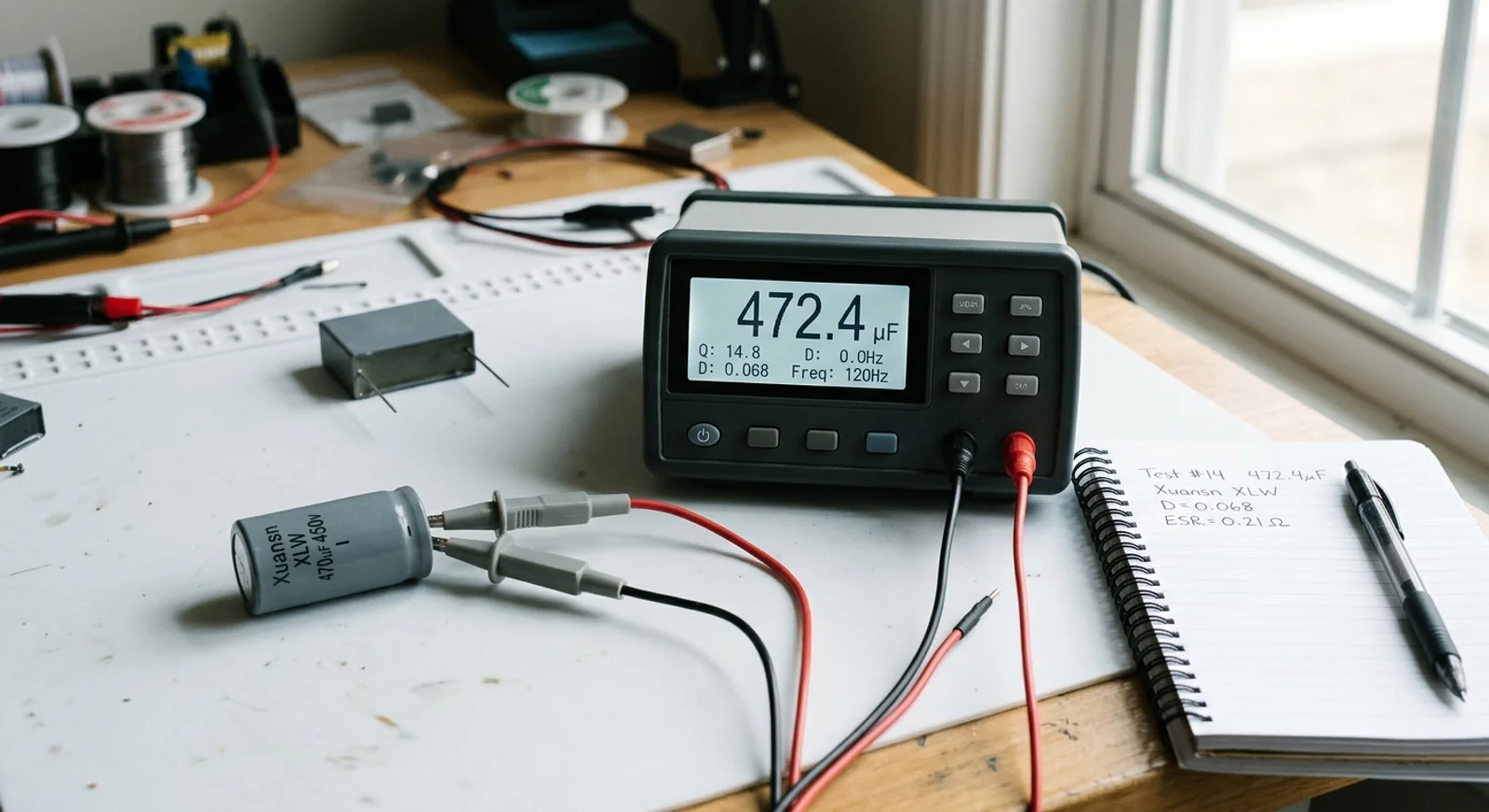
Start with electrical verification at the operating point rather than the datasheet point. Measure capacitance, ESR and impedance across the frequency range the circuit actually uses, and confirm the part meets the ripple current requirement with the temperature rise you measured, not the one the catalogue assumes. For ceramic parts, measure effective capacitance at the DC bias the rail applies.
Then environmental. Run the candidate through the temperature range the product will see, including the extremes the datasheet ratings imply rather than the comfortable middle. Where the application is safety-related or long-service, ask for load life data at the actual operating temperature and check whether the endurance curve supports the product’s service window.
System-level checks come next, and they catch what bench testing misses. Switching regulators that were stable with one capacitor can oscillate with another, because ESR and ESL set the compensation network’s behaviour. Conducted and radiated emissions can shift. Inrush behaviour on a bulk capacitor changes with ESR, which can trip protection circuits on startup.
Finish with a pilot build rather than a full release. A single production lot exposes handling, placement and process issues that no bench test will reveal, and it keeps the exposure small if something surfaces.
What a Wider Approved List Costs You
Every substitute added to the approved vendor list carries a maintenance cost. More part numbers mean more incoming inspection, more inventory lines, more supplier relationships to manage, and more chances that a purchasing decision made under pressure quietly changes the electrical behaviour of a product. The saving is real. So is the overhead.
The sensible split is between parts worth dual-sourcing permanently and parts where substitution is a one-time bridge. Components with long lead times, single-source risk or high value per unit earn a permanent second source and a documented qualification file. Commodity parts that happen to be temporarily constrained are better handled by a short-term deviation with an expiry date, so the approved list does not accumulate substitutes nobody revisits.
Where the Series Goes Next
The first two articles covered the market and the procurement response. This one covered the engineering response. The next piece looks at the design side: how to specify capacitor positions so that a future shortage does not force a redesign, which means thinking about ripple margin, voltage derating and approved alternates at the schematic stage rather than during a supply crisis.
For a closer look at one specific crossing, the comparison of MLCC and film capacitors covers where film genuinely substitutes for ceramic and where it does not, with the DC bias behaviour that drives most of the difference.
Common Questions About Capacitor Substitution
Can I replace an aluminum electrolytic capacitor with a film capacitor?
In DC-link, snubber and high-ripple positions, yes, and the result is often a longer-lived circuit. The constraint is volume and cost. Film capacitors store less energy per unit of volume than aluminum electrolytics, so matching a large bulk capacitance can take several times the space. If the enclosure is fixed, the swap usually fails on physical grounds before it fails electrically.
Is a higher voltage rating always a safe substitute?
Higher voltage rating is safe from a dielectric stress standpoint, but it is not free. A higher-rated part of the same capacitance is physically larger, which affects layout and can change ESL. In ceramic parts, moving to a higher voltage rating within the same case size usually means fewer active layers and lower effective capacitance. Always compare effective capacitance at the operating voltage rather than nominal capacitance.
Does substituting a capacitor require re-certification?
It depends on where the part sits. Components in a certified safety function, including X and Y safety capacitors and parts listed in an automotive or medical approval, generally require the certification to be revisited. Parts in ordinary filtering or bulk positions typically do not, provided the substitution stays within the approved specification and the change is documented. When in doubt, treat anything with a safety agency listing as a re-certification item.
How long does it take to qualify a second source?
For a same-type part with a comparable datasheet, a focused qualification can take a few weeks: electrical verification, a temperature run and a pilot lot. Cross-type substitutions run longer because the design margins have to be re-established, and a design change takes longer still. The qualification time is usually shorter than the lead time it is meant to solve, which is the argument for starting before the shortage reaches your part number.
Xuansn manufactures aluminum electrolytic, film, polymer and supercapacitors, and has supplied through previous shortage cycles. Because we build across several capacitor families, we can tell you whether a proposed substitution is feasible on our own lines rather than sending you to a third party for the answer. Our complete guide to capacitor types covers where each family fits, and our aluminum electrolytic selection guide covers the parameters that matter most when comparing parts across suppliers.
Evaluating a substitute for a part you cannot source? Send us the original specification and the position it sits in. Our engineers will confirm feasibility and reply with a quote within 24 hours.
✉ [email protected] | ☎ +86-769-8166 8821 | Send your specification