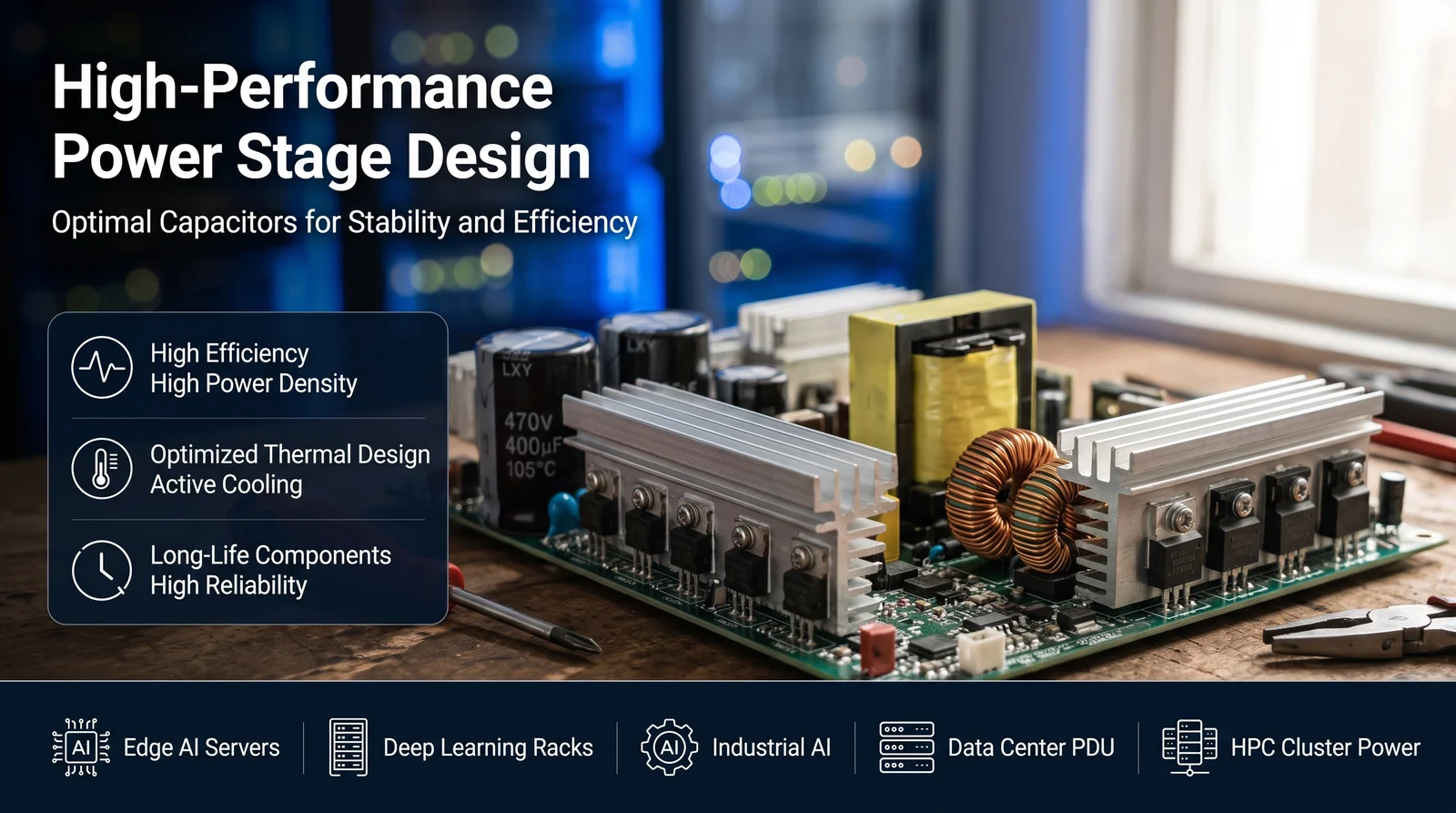
An AI server power chain is a stack of voltage rails, not one part. From the 380 V rectified bus at the inlet to a 1 V GPU core, every stage has a different job and every stage pulls a different capacitor. Getting the choice right at each level is where AI-optimized power supplies earn their efficiency – and where the wrong part fails first.
This is the third article in our AI server series. In the first article we looked at how AI server power demand is exploding, and in the second at how capacitors work in a switching power supply. Here we map the capacitors onto each power stage of a server, so you can see which type does what – and which one your design actually needs.
Riding the Rail Down From 380 V to 1 V
Think of the server power delivery path as a train running down a voltage line. The alternating input is rectified to a high-voltage DC bus near 380 V. That bus feeds a converter that steps down to a 48 V intermediate rail – the distribution voltage adopted by most modern AI racks. A second stage of point-of-load converters takes that 48 V down to the sub-1 V cores and the 1.8 V memory rails that GPUs and CPUs actually run on.
Each of these steps needs a different capacitor, because the job is different at each voltage and current level.
| Rail | Typical voltage | Main job | Capacitor best suited |
|---|---|---|---|
| Input / PFC bus | ~380 V DC | Rectifier smoothing, hold-up | Aluminum electrolytic |
| Intermediate bus | 48 V | Bulk energy, fast transient response | Polymer / solid, aluminum electrolytic |
| Point-of-load rails | 0.8-1.8 V | Decoupling, noise suppression | MLCC (larger capacitance, e.g. X5R/X7R) |
| Backup / ride-through | varies | Extended hold-up beyond the AC loss event | Supercapacitor bank |
The pattern is simple: the further down the rail you go, the lower the voltage and the faster the transients – and the more the capacitor choice shifts from big capacitors doing bulk storage to many small ones doing decoupling.
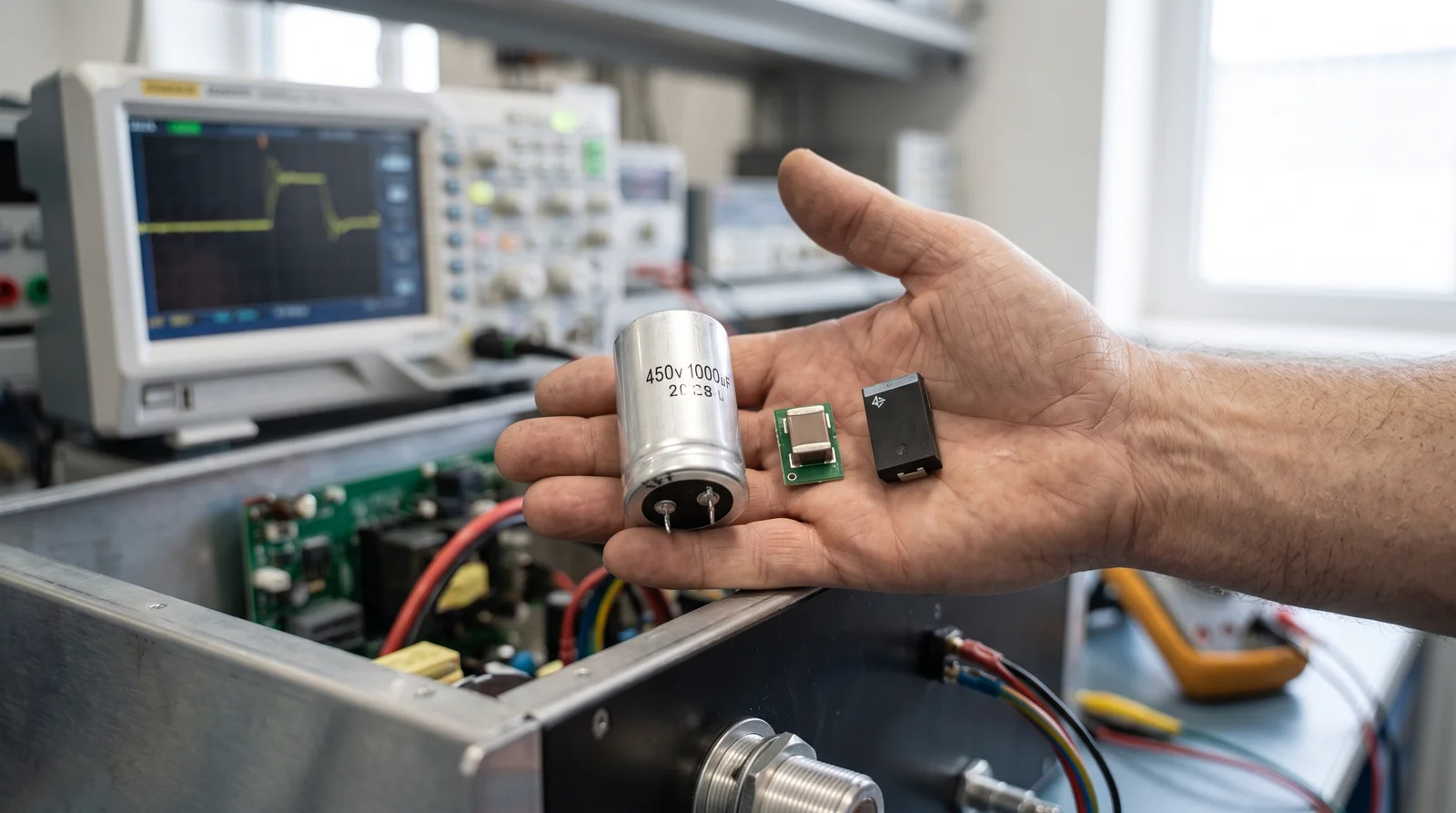
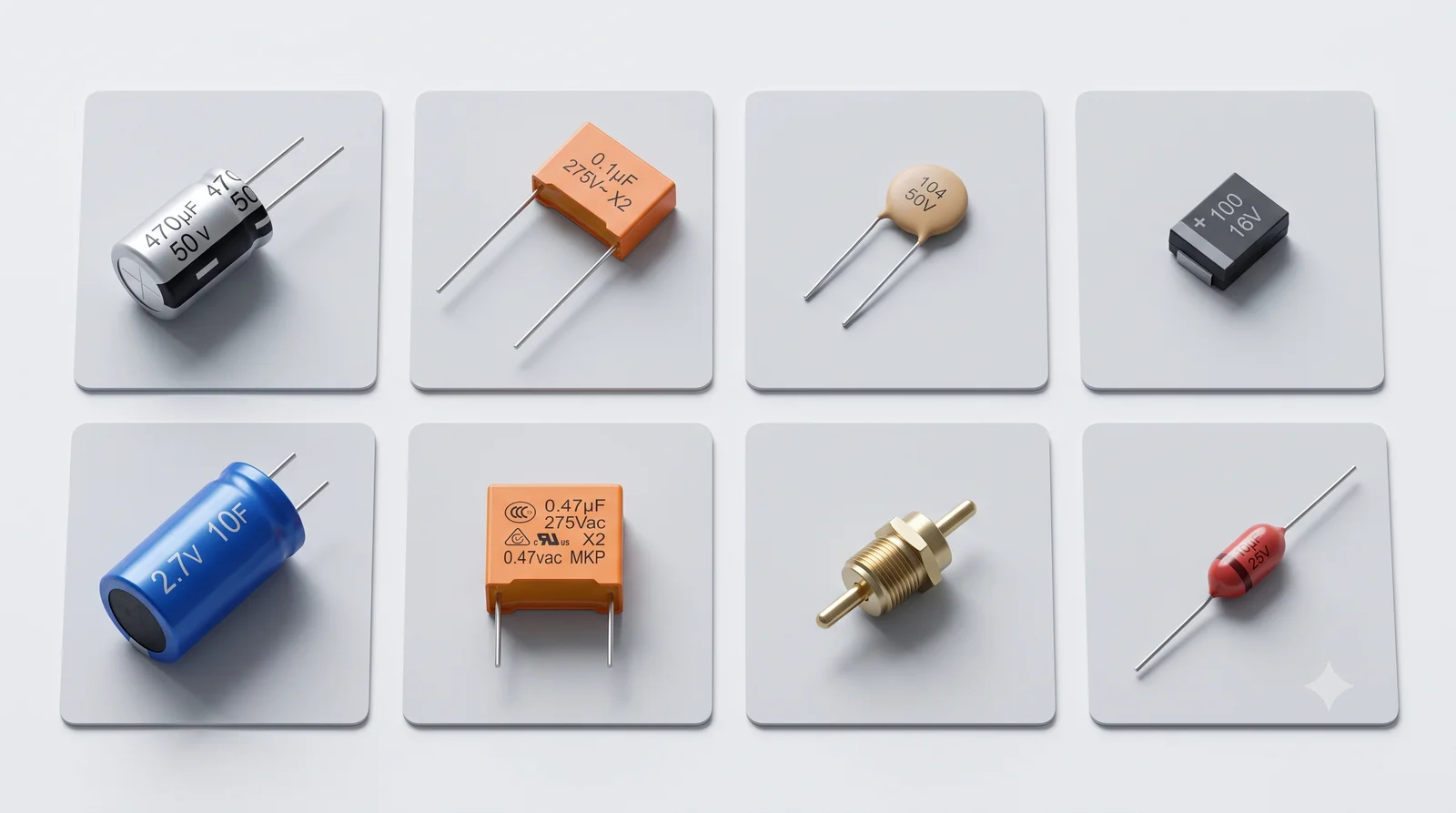
Four Capacitors, Four Different Jobs
Aluminum electrolytic – the hold-up workhorse
Right after the rectifier, an aluminum electrolytic capacitor smooths the high-voltage bus and stores the energy that keeps the server alive during a few milliseconds of AC loss. Its job is defined by hold-up time – the window after input power drops during which the output still stays in regulation. Most server and ATX power specs ask for 16 to 20 ms of hold-up, with some enterprise requirements settling at a 10 ms minimum. That is why bulk electrolytic capacitors with high ripple-current ratings and long 105 °C lifetime dominate the primary side.
Polymer and solid capacitors – response where the load steps
On the 48 V intermediate bus, the load changes fast as GPUs boost. A polymer or solid aluminum capacitor offers much lower ESR than a wet electrolytic, so it can answer a load step without letting the rail sag. That lower ESR also means less self-heating for the same ripple current, which is exactly what a power-hungry AI rail demands.
MLCC – decoupling at the edge
At the point-of-load, tens or even hundreds of small MLCCs sit right next to the GPU core. At sub-1 V, the capacitance needed is small but the switching frequency is high, so what matters is low ESL, high-frequency response and placement as close to the die as possible. This is the decoupling role, distinct from the bulk role upstream. If you want the full argument for why this matters, our pillar on all capacitor types walks through the trade-offs in depth.
Supercapacitors – the ride-through option
When 16-20 ms of hold-up is not enough – say, a longer ride-through window or a battery-less BBU design – a supercapacitor bank can take over. A bank built from 2.7 V-class cells handles seconds of backup where an electrolytic would need an impractically large can. It is a different trade: lower voltage per cell, balancing circuits required, but a far longer ride-through for the same footprint trade-off.
Choosing by Rail: A Practical Comparison
| Type | Typical capacitance | ESR characteristic | Best rail | Lifetime driver |
|---|---|---|---|---|
| Aluminum electrolytic | µF to mF | Moderate, rises with age | Input bus, bulk hold-up | Ripple current, 105 °C class |
| Polymer / solid | µF to low m | Very low, stable | 48 V intermediate bus | Fewer aging mechanisms |
| MLCC | nF to low µF | Very low, frequency-dependent | Core-point-of-load | Voltage derating on X5R/X7R |
| Supercapacitor | F to thousands of F | Moderate, cell-stacked | Battery-less back-up | Cycle count, calendar life |
The pattern here is equally practical. Near the inlet, you want big capacitance and rated ripple – the aluminum electrolytic territory we build at aluminum electrolytic capacitors. On the 48 V bus, solid capacitors answer fast load steps. At the core, ceramic capacitors (MLCC) do the high-frequency decoupling. And when your backup window stretches past 20 ms, a supercapacitor bank is the option to compare.
Where Xuansn Fits
You rarely need a single capacitor – you need the right one at every rail. That is why Xuansn builds the full set: aluminum electrolytic, polymer and solid, MLCC, and supercapacitors. Whether you are upgrading an existing AI rack or sourcing a new PSU, the same question applies: which rail is your weak point?
Deeper dives live on our specialist sites: the aluminum electrolytic site covers 48V/800V architectures, and the supercapacitor site walks through BBU and UPS designs. Start here, then follow the rail to the detail.
What’s Next in the AI Server Series
This article mapped the capacitors onto the rails, building on the principles of how capacitors work in a switching power supply. The next piece turns the map into a concrete selection and sourcing plan – how to compare offerings, what to ask a manufacturer, and where to start when you are sourcing AI power capacitors.
Common Questions
Do AI servers really use supercapacitors?
They can, but not in every PSU. In a standard AI server PSU, the bulk and hold-up job belongs to aluminum electrolytics. Supercapacitors appear where you need sec-scale ride-through or a battery-less BBU – a separate power-path decision, not a drop-in swap on the same rail.
What size capacitor do I need for an AI server?
It depends entirely on the rail. For the input bus you size for hold-up energy at the bus voltage window; for the core you size for the load step and switching frequency. Give us the rail, load and hold-up target and we will help you pick – rather than guess from a single number.
Can one capacitor type handle the whole AI power chain?
No – and that is the point of this article. A high-voltage bus calls for bulk, a 48 V rail for low-ESR response, and a sub-1 V core for high-frequency decoupling. Each stage rewards a different capacitor, which is why a mixed set is the norm in serious AI power stages.
Get a quote from Xuansn
Email: [email protected]