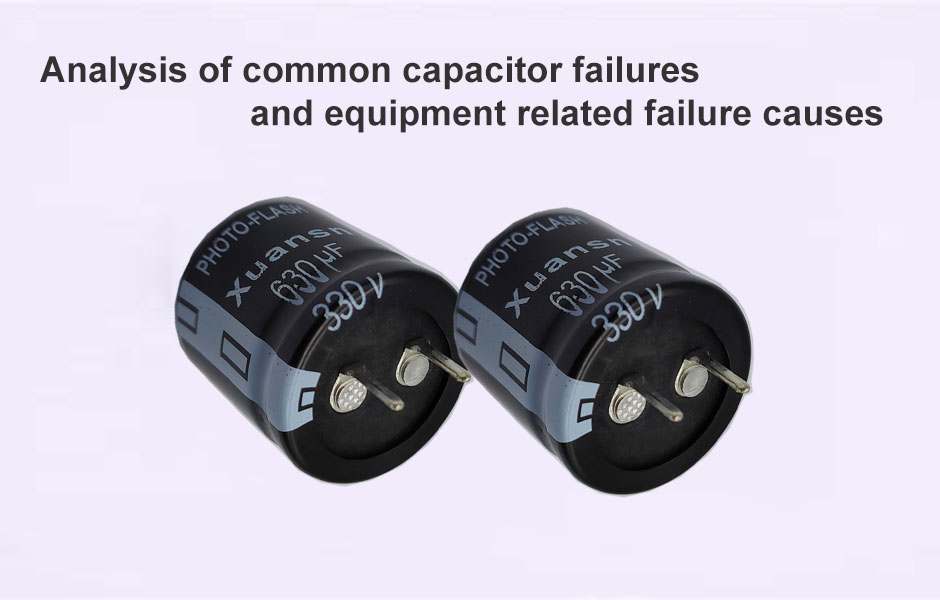
Many people encounter a core problem when repairing electronic equipment and troubleshooting circuit issues: how to test the quality of capacitors? Capacitors are one of the most commonly used and most easily aged components in electronic equipment. Once they malfunction, it can lead to anything from minor malfunctions to serious damage such as burning out the motherboard and power supply. Especially for beginners, mastering scientific capacitor testing methods can quickly locate faults and avoid the costly waste of blindly replacing capacitors. This article provides a detailed breakdown of how to test capacitors, from basics to practical application, teaching you how to perform capacitor tests using simple tools. Whether you are an electronics enthusiast or a repair novice, you can easily get started by following the steps.

I. Must-Read Before Testing: Basic Capacitor Knowledge and Safety Precautions

Before learning how to test capacitors,, clarify two core points—understanding the basic characteristics of capacitors and taking proper safety precautions. This is crucial to avoiding misoperation and accidents, and is also a prerequisite for correctly testing capacitors.

1. Core Characteristics of Capacitors (Essential for Beginners)

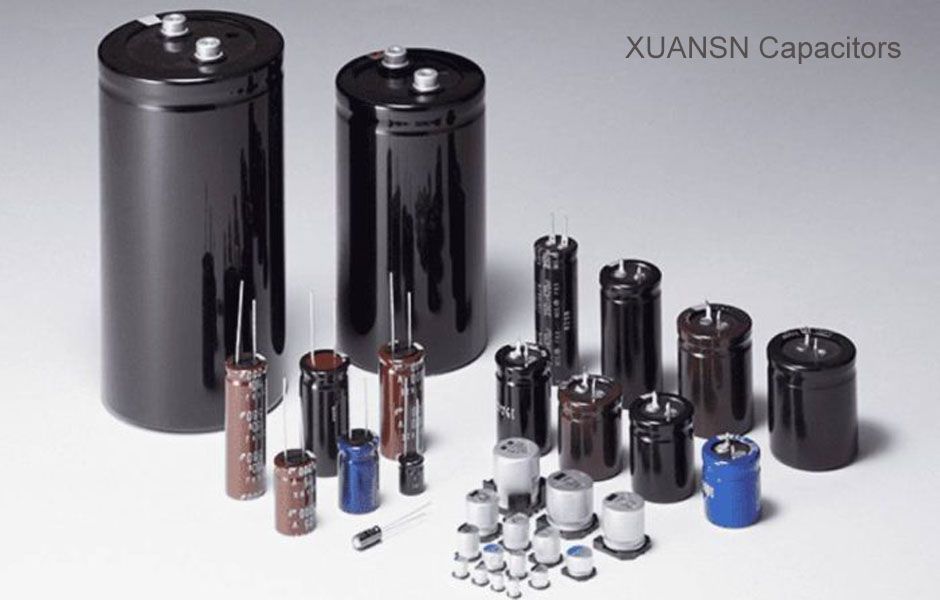
To understand how to test capacitors, you must first understand their core parameters: capacitance (unit: Farad F, commonly microfarads μF, nanofarads nF), rated voltage (unit: Volt V), and some capacitors also have polarity (such as electrolytic capacitors). These parameters directly affect the operation method of capacitor testing and require close attention during testing to avoid conflicts with test tool settings that could affect test results.

Common Fault Types (Key Areas to Check During Testing): Capacitance decay (different types of capacitors have different tolerances; for example, electrolytic capacitors are typically ±20%, ceramic and film capacitors are typically ±5% or ±10%, and tantalum capacitors are typically ±10% or ±20%; exceeding the corresponding tolerance is considered abnormal), leakage (bulging of the electrolytic capacitor casing, leakage), short circuit (continuity between positive and negative terminals), open circuit (no capacitance response). These faults are also core issues we need to diagnose when testing capacitors; understanding them beforehand will make the testing more targeted.

2. Safety Precautions (Top Priority)

Safety is the most important step when learning how to test capacitors.

– Power Discharge: Capacitors store charge. Even when the equipment is powered off, high-voltage charges may remain. Direct testing can easily lead to electric shock or damage to test tools. The first step in testing capacitors is to completely discharge them. Large-capacity capacitors can be discharged through a series resistor, while small-capacity capacitors can be directly short-circuited with a wire between the positive and negative terminals.

– Distinguishing Polarity: Electrolytic capacitors and tantalum capacitors have positive and negative terminals. During testing, the positive and negative terminals must not be reversed, otherwise the capacitor or testing instrument may be damaged. This is a crucial point to note when testing polarized capacitors.

– Matching Range: The range of the testing tool (such as a multimeter) must match the capacitor’s capacitance and voltage. Avoid using a range that is too small to test, or a range that is too large, leading to errors and affecting the accuracy of the test results.

II. Pre-Test Preparation: Tools and Capacitor Pre-treatment

Preparing appropriate tools and pre-treating the capacitors will make capacitor testing more efficient and accurate. Beginners don’t need complex tools; a basic kit can meet all their capacitor testing needs, making capacitor testing easy.

1. Essential Testing Tools (Beginner’s Kit)

– Digital Multimeter (Core Tool): It is recommended to choose a multimeter that supports the capacitance range (marked with “Cx”). This offers higher accuracy and simpler operation, making it the preferred tool for beginners to test capacitors and the core equipment for capacitor testing.This is the easiest and most reliable tool for beginners learning how to test capacitors.

– Auxiliary Tools: Screwdriver (for disassembling the device casing to easily remove the capacitor), wires (for discharging), resistor (for discharging large-capacity capacitors, 100Ω-1kΩ recommended), magnifying glass (for observing the capacitor’s appearance and checking for obvious faults).

2. Capacitor Pre-treatment Steps

1. Power Off: Disconnect the device power supply and unplug the plug. Wait 5-10 minutes (allow the internal capacitors to discharge naturally; large-capacity capacitors require manual discharge, this is the first step for testing safety).

2. Disassembly: Use a screwdriver to open the device casing and locate the capacitor to be tested (usually black, cylindrical or square, with capacitance and voltage parameters printed on the casing for easy range matching during subsequent testing).

3. Discharging: For electrolytic capacitors with a capacitance ≥100μF, connect the positive and negative terminals with a series resistor and discharge for 1-2 minutes. For small-capacity capacitors (<100μF), directly short-circuit the positive and negative terminals with a wire to discharge (instantaneously), ensuring no residual charge remains.

4. Visual Inspection: Observe the capacitor’s appearance with a magnifying glass. If bulging, leakage, cracked casing, or oxidation/rusting of the leads are found, the capacitor is directly considered damaged, requiring no further testing and saving testing time.

III. Core Testing Methods: 4 Commonly Used Methods Covering All Scenarios

Based on the capacitor type (polarized or non-polarized) and capacitance value, we recommend four of the most practical methods for how to test capacitors, ranging from simple to precise. Beginners can start with the visual inspection method or the capacitance setting on a multimeter, while more advanced users can use the resistance setting method to easily master capacitor testing and handle different troubleshooting scenarios.

Digital multimeter for testing capacitors

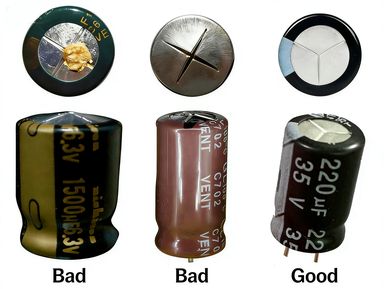
Method 1: Visual Inspection (Fastest and Most Basic)

No tools are needed. By observing the capacitor’s appearance, most obvious faults can be quickly identified. This visual inspection method is often the first step when learning how to test capacitors, making it suitable for initial screening and beginners. It is also one of the simplest and most convenient capacitor testing methods.

– Normal Capacitors: Intact casing, no bulging, no leakage, no oxidation on the leads, and clear printed parameters. These can be initially judged as normal, but further confirmation using other methods is needed.

– Abnormal Capacitors (Directly Indicate Damage):

– Electrolytic Capacitors: Bulging casing, top protrusion (some capacitors have explosion-proof markings on the top; protrusion indicates an abnormality), leakage (brown/black liquid on the bottom of the casing or at the leads). These capacitors do not require further testing and can be replaced directly.

– All Types of Capacitors: Cracked casing, detached leads, severe oxidation (leads are blackened, rusted, and cannot be soldered properly) all indicate damage.

Note: A capacitor with a normal appearance does not necessarily mean it is internally fault-free. Further testing using other methods is necessary to avoid misjudgment.

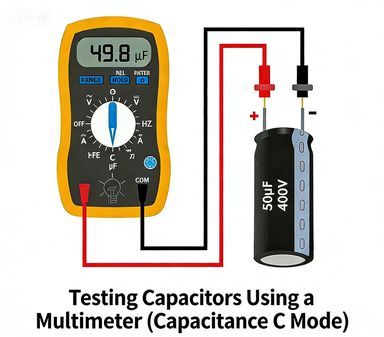
Method 2: Multimeter Capacitance Testing (Most Accurate and Commonly Used)

This is the most recommended method for beginners when learning how to test capacitors. It is simple to operate, provides accurate results, and directly measures the actual capacitance of the capacitor. By comparing the measured value with the nominal value, you can quickly determine the capacitor’s condition. It is the most common and core method for testing capacitors and the preferred approach when using a multimeter, suitable for most capacitor testing scenarios.

1. Multimeter Settings: Turn the multimeter knob to the “Cx” range (capacitance range). Select the appropriate range according to the capacitor’s nominal capacitance (e.g., 200μF for a 100μF capacitor; 2nF for a 1nF capacitor) to avoid range mismatch leading to errors.

2. Capacitor Discharge: Double-check that the capacitor is completely discharged (to avoid residual charge affecting test results; this is crucial for accuracy).

3. Wiring Test:

  • Non-polarized Capacitors (e.g., ceramic capacitors, polyester capacitors): Connect the red and black probes of the multimeter to any two leads of the capacitor. Wait 1-2 seconds; the multimeter reading is the actual capacitance.
  • Polarized capacitors (such as electrolytic capacitors and tantalum capacitors): Connect the red probe of the multimeter to the positive terminal of the capacitor and the black probe to the negative terminal. Wait 1-2 seconds and read the actual capacitance. Do not reverse the probes.

4. Result Interpretation: Different types of capacitors have different tolerance standards. For example, electrolytic capacitors are usually ±20%, ceramic and film capacitors are usually ±5% or ±10%, and tantalum capacitors are usually ±10% or ±20%. Within this range, the capacitor can be used normally.If the error exceeds the tolerance range of the corresponding type of capacitor, or if the display shows “0” (short circuit) or “1” (open circuit), the capacitor is damaged and needs to be replaced.

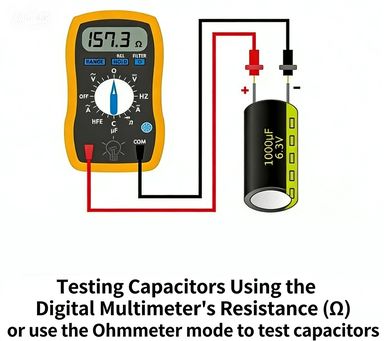
Method 3: Multimeter Resistance Range Testing (Auxiliary Testing, Determining Capacitance)

If your multimeter doesn’t have a capacitance range, you can use the resistance range. This primarily checks for short circuits or open circuits, but it doesn’t accurately measure capacitance. It’s suitable for emergency use, solving the problem of how to test capacitors when no dedicated range is available. It’s a supplementary capacitor testing method, assisting in multimeter capacitor testing.

The specific emergency operating steps are as follows, allowing you to quickly determine the condition of a capacitor without the capacitance range:

1. Multimeter Settings: Turn the multimeter knob to the resistance range (marked “Ω”) and select an appropriate range (200kΩ for large capacitance capacitors, 2MΩ for small capacitance capacitors).

2. Capacitor Discharge: Ensure the capacitor is completely discharged to avoid the charge affecting the test results and ensure testing safety.

3. Wiring Test:

  • Non-polarized Capacitors: Connect the red and black probes to any of the capacitor leads and observe the multimeter pointer changes.
  • Polarized Capacitors: Connect the red probe to the positive terminal and the black probe to the negative terminal. Observe the pointer change to avoid reversing the connection.

4. Result Judgment:

  • Normal capacitor: The pointer deflects rapidly and then slowly returns to near infinity (∞), indicating that the capacitor can charge and discharge normally.
  • Open circuit capacitor: The pointer does not move at all or directly displays 0, indicating an internal open circuit or inability to charge.
  • Short circuit capacitor: The pointer points directly to 0Ω, indicating an internal short circuit.
  • Severe leakage: The pointer deflects and stops at a finite resistance value instead of near ∞, indicating that the capacitor is leaking and needs to be replaced.

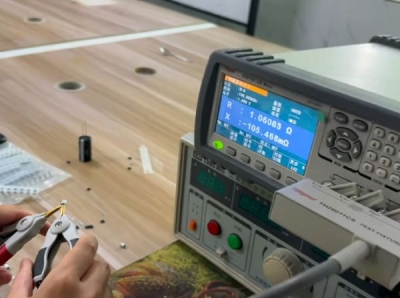
Method 4: ESR Test (Essential for Professional Repair, Highly Recommended)

This is the most practical and accurate method for diagnosing latent capacitor faults in professional electronics repair, and it is also an advanced technique for those who want to fully understand how to test capacitors. Many capacitors may appear to have normal capacitance (within the specified tolerance range), but their actual equivalent series resistance (ESR) can be too high. This can lead to abnormal equipment operation, especially in high-frequency circuits such as switching power supplies, motherboards, and graphics cards. These hidden faults are very common and cannot be detected by the first three methods alone. ESR testing can effectively solve this problem.

ESR (Equivalent Series Resistance) is the equivalent resistance inside a capacitor. An excessively high value indicates capacitor performance degradation and internal aging. Even if the capacitance meets specifications, it can affect circuit stability, leading to problems such as overheating, unstable power supply, and system crashes. This is considered a “latent failure” of the capacitor.

Testing Tools

A dedicated ESR tester (ESR Meter) eliminates the need to remove the capacitor (some models support online testing). It is easy to operate, highly accurate, and an essential tool for professional repair technicians testing capacitors.

Detailed Operating Steps

1. Instrument Calibration: Turn on the ESR tester and complete the calibration according to the instrument’s instruction manual (some entry-level models do not require calibration and can be used immediately upon power-on) to ensure testing accuracy.

2. Capacitor Pre-treatment: For offline testing, the capacitor must be removed from the circuit and thoroughly discharged (to avoid residual charge affecting test results). If the instrument supports online testing, testing can be performed directly on the circuit board without removal, saving time.

3. Wiring Test: Connect the red and black probes of the ESR tester to the positive and negative terminals of the capacitor (polarized capacitors require distinguishing between positive and negative terminals; non-polarized capacitors can be connected arbitrarily). Wait 1-2 seconds and read the ESR value displayed on the tester.

4. Result Interpretation: Different capacitance and type capacitors have different standard ESR values ​​(generally, the larger the capacitance, the lower the standard ESR value). Generally, if the ESR value exceeds twice the corresponding standard value, the capacitor is considered faulty and needs to be replaced immediately.

Applicable Scenarios and Precautions

– Applicable Scenarios: Primarily used for capacitor testing in high-frequency circuits such as switching power supplies, motherboards, graphics cards, and home appliance control boards. It is especially suitable for troubleshooting hidden faults where “the capacitance is normal but the device malfunctions.” It is a core method for testing hidden capacitor failures.

– Precautions: Ensure the capacitor is completely discharged during testing to avoid residual charge damaging the ESR tester; when testing online, avoid interference from other components in the circuit to ensure accurate test results; the operation of different ESR tester models varies slightly, so refer to the instruction manual.

IV. Key Points for Testing Different Types of Capacitors (Targeted Operation)

Different types of capacitors have different structures and characteristics. Therefore, the testing methods must be tailored to specific needs to avoid misjudgments and ensure accurate test results. This will allow each type of capacitor to be tested using appropriate capacitor testing methods.

Capacitor Types Test Focus Precautions
Electrolytic Capacitors (Polarized) 1. Check for bulging or leakage; 2. Check if the actual capacitance is within ±20% tolerance;

3. Check for leakage.

During testing, the positive and negative terminals must not be reversed, and discharge must be complete to avoid damaging the capacitor
Ceramic Capacitors (Non-Polarized) 1. Check for cracks; 2. Check if the actual capacitance is within ±5% or ±10% tolerance; 3. Check for short circuits. Due to their smaller capacitance, a suitable range must be selected during testing to avoid environmental interference.
Tantalum Capacitors (Polarized) 1. Check for damage; 2. Check for short circuits or open circuits; 3. Check if the capacitance is within the corresponding tolerance range (usually ±10% or ±20%); 4. Tantalum capacitors are easily damaged by overcurrent or overvoltage; extra care must be taken to match the range during testing to avoid breakdown. Not resistant to high voltage; avoid excessive range during testing; positive and negative terminals must not be reversed.
Film capacitor (non-polarized) 1. Check for external damage or leakage; 2. Check if the capacitance is within ±5% or ±10% tolerance; 3. Check for leakage. Commonly used in high-voltage scenarios; ensure complete discharge before testing to avoid electric shock.

V. Common Testing Misconceptions and Precautions (A Guide to Avoiding Pitfalls)

Newcomers to capacitor testing often fall into some misconceptions, leading to misjudgments or safety accidents. The following points must be remembered to help you correctly master capacitor testing, standardize capacitor testing methods, avoid pitfalls, and ensure safe and accurate operation of multimeter testing of capacitors and other testing methods.

– Misconception 1: Testing without discharging. Consequence: Residual charge may cause electric shock or damage to the multimeter and capacitor. This is the most dangerous misconception in capacitor testing.

– Misconception 2: Reversing the probes of polarized capacitors. Consequence: Inaccurate test results; in severe cases, damage to the capacitor or multimeter, affecting test judgment.

– Myth 3: Inappropriate range selection. Consequence: Testing large-capacity capacitors with a small range will display “overflow”; testing small-capacity capacitors with a large range will result in excessive error and inaccurate results.

– Myth 4: Judging capacitor quality solely by appearance. Consequence: Capacitors that appear normal may have internal faults such as capacitance decay or leakage, leading to incomplete troubleshooting and affecting repair effectiveness.

– Note: After testing, if the capacitor is confirmed to be intact, it can be reinstalled and used; if damaged, it must be replaced with a capacitor with the same nominal capacitance and rated voltage (the rated voltage of the replacement capacitor must not be lower than that of the original capacitor, and the capacitance error must meet the tolerance standard for the corresponding type of capacitor—electrolytic capacitors are typically ±20%, ceramic and film capacitors are typically ±5% or ±10%, and tantalum capacitors are typically ±10% or ±20%).

VI. Summary: A Beginner’s Guide to Quickly Mastering the Core Process of “How to Test Capacitors”

The core logic of capacitor testing is actually quite simple. Beginners only need to remember three core steps: power off and discharge → visual inspection → tool testing → result judgment → replacement of faulty capacitor. Mastering this process will allow you to easily complete various capacitor tests and flexibly apply different capacitor testing methods. Professional repair personnel can additionally master the ESR testing method to accurately troubleshoot hidden capacitor faults.

For beginners, prioritizing mastering the “visual testing method + multimeter capacitance setting” will solve more than 80% of capacitor testing needs. Advanced users can learn the resistance setting to handle emergency scenarios. Professional repair personnel can focus on mastering the ESR testing method to troubleshoot hidden faults where the capacitance is normal but the ESR is too high. As long as safety precautions are taken and the steps are followed, you can quickly and accurately test capacitors, become proficient in various capacitor testing methods, easily troubleshoot electronic equipment faults, and truly learn how to test capacitors.

FAQ – How to Test Capacitors

Q1: Can I test a capacitor without a multimeter?
A: Yes, but only for a rough check. You can perform visual inspection to look for bulging, leakage, cracks, or corrosion. For a more accurate check, using a multimeter (capacitance or resistance mode) or an ESR tester is recommended. Visual inspection alone cannot detect internal degradation or high ESR faults.


Q2: How do I safely discharge a high-voltage capacitor?
A:

  • Use a series resistor (100Ω–1kΩ, rated for the voltage) to discharge large capacitors slowly.

  • Wear insulated gloves and use insulated tools.

  • Never short a high-voltage capacitor directly.

  • For extremely high-voltage capacitors (>400V DC or >250V AC), consider professional equipment or guidance.


Q3: What is ESR and why is it important?
A: ESR (Equivalent Series Resistance) is the internal resistance of a capacitor. A high ESR can cause:

  • Overheating

  • Unstable voltage

  • Circuit malfunction
    Even if the capacitance is normal, a high ESR can lead to hidden failures, especially in switching power supplies, motherboards, and graphics cards. ESR testing is crucial for detecting these latent faults.


Q4: Can I reverse the probes on a polarized capacitor?
A: No. Reversing probes on electrolytic or tantalum capacitors can damage the capacitor or the multimeter. Always connect red → positive, black → negative. Double-check the polarity before testing.


Q5: Why does my multimeter show “0” or “OL” when testing a capacitor?
A:

  • “0” → capacitor is short-circuited internally.

  • “OL” or 1 → capacitor is open circuit or not charging.
    In both cases, the capacitor is faulty and needs to be replaced.


Q6: Can small ceramic capacitors be tested accurately with a regular multimeter?
A: Accuracy is limited for very small capacitance values (pF–nF). For precise measurement, use an LCR meter or dedicated capacitance tester.


Q7: After testing, can I reuse a capacitor?
A:

  • If the capacitor passes all checks (visual + electrical), it can be reinstalled.

  • If damaged, replace it with a capacitor of the same capacitance and equal or higher rated voltage, respecting the tolerance standard for the capacitor type.


Q8: How do I know which testing method to use?

  • Beginners: Visual inspection + multimeter capacitance mode.

  • Intermediate: Multimeter resistance mode for emergency checks.

  • Professional: ESR testing for hidden faults in high-frequency circuits.