What Is a Good Capacitor? Five Measures That Matter More Than the Brand
“What is a good capacitor?” sounds like a simple question, but it gets the wrong answer constantly in sourcing meetings and repair benches. A glossy brand, a high price tag, or a fat capacitance number does not make a capacitor good. A capacitor is good when its measurable parameters fit the circuit it sits in — and those parameters are narrower and more specific than most buyers expect.
This article skips the marketing language and looks at five things you can actually measure and compare: capacitance tolerance, equivalent series resistance (ESR), dissipation factor, leakage current, and temperature behaviour. It also corrects three popular misconceptions that drive bad buying decisions.
Three common myths, quickly retired
“The bigger the capacitance, the better”
Larger capacitance does give an IC stronger current compensation, but a bigger value also lowers the capacitor’s self-resonant frequency. Every real capacitor carries parasitic inductance, and the circuit formed by the capacitor and that inductance resonates at one frequency; only near that resonance does the part deliver current effectively. Above it, the capacitor behaves like an inductor and stops helping. So a very large capacitor can be nearly useless at exactly the frequency where a small one shines. This is why good board design pairs a small high-frequency part with a larger bulk part instead of picking one big value.
“More small capacitors in parallel is always better”
Parallel parts do add capacitance and lower combined ESR — in theory. In practice every solder joint and trace adds impedance of its own, so past a certain point extra parallel parts buy nothing except cost and layout trouble. The right number is the number the design actually needs, not the maximum you can fit.
“The lower the ESR, the better”
Low ESR is genuinely important for switch-mode power supplies, but too low is a real problem: a very low-ESR output capacitor can make the switching loop oscillate, which forces you to add damping circuitry that costs more than the capacitor saved. ESR should meet the design’s target, not race toward zero.
The five measures that define a good capacitor
1. Capacitance and tolerance
Capacitance is the first spec, but tolerance is where quality shows. A ±20% part and a ±5% part can share the same nominal value yet behave very differently in a timing or filtering circuit. Class 2 ceramics such as X7R and X5R also lose capacitance under DC bias — an X7R part can lose 20% or more of its rated capacitance at half its rated voltage — so a “10 µF” part may not be 10 µF in circuit. If you need to read capacitor values and their units correctly, our guide on what µF means on a capacitor walks through the marking system in detail.
2. Equivalent series resistance (ESR)
ESR is the real, lossy part of a capacitor’s impedance. It comes from electrode and dielectric losses and ranges from milliohms for ceramics and film parts up to several ohms for some electrolytic capacitors. ESR changes with frequency and temperature, generally falling as frequency rises, and it determines how much heat the capacitor generates under ripple current. For a power supply output, low ESR is essential; for a resonant circuit, it affects Q directly. Always compare ESR at the frequency your circuit actually operates at, not at the frequency printed on the datasheet cover.
3. Dissipation factor (DF / tan δ)
Dissipation factor, also called loss tangent, is the ratio of ESR to capacitive reactance and is expressed as a percentage. Its reciprocal is the quality factor Q. The dielectric largely sets it: polypropylene film capacitors show very low DF (roughly 0.5 to 5 at 1 kHz), while polyester film runs far higher (roughly 50 to 200 at 1 kHz). If you are comparing film parts for an application where losses matter, this single number separates a good choice from a poor one faster than anything else.
4. Leakage current and insulation resistance
Leakage current is the current that flows through the dielectric after the capacitor has been charged at rated voltage for several minutes. It is set by insulation resistance and, for aluminium electrolytic capacitors, roughly follows Il ≤ 0.01 × CR × UR (or 1 µA, whichever is larger) for small values of CR × UR. Leakage roughly doubles at 85 °C and 125 °C compared with the 25 °C limit, and rises with applied voltage — which is why derating matters. Film and ceramic capacitors leak far less than electrolytic types, which is why precision and timing circuits prefer them.
5. Temperature behaviour and lifetime
A capacitor that meets every spec at 25 °C can fall apart at its operating temperature. Class 2 ceramics shift capacitance with temperature (X7R holds about ±15% from -55 °C to +125 °C; X5R holds ±15% over a narrower -55 °C to +85 °C), while electrolytic capacitors wear out: their lifetime halves roughly for every 10 °C above the rated temperature. For a long-life application, check the ripple current rating and the lifetime hours at the actual ambient temperature, not the marketing headline. Our electrolytic capacitor range publishes lifetime ratings precisely because this number decides service life in the field.
How to measure it yourself
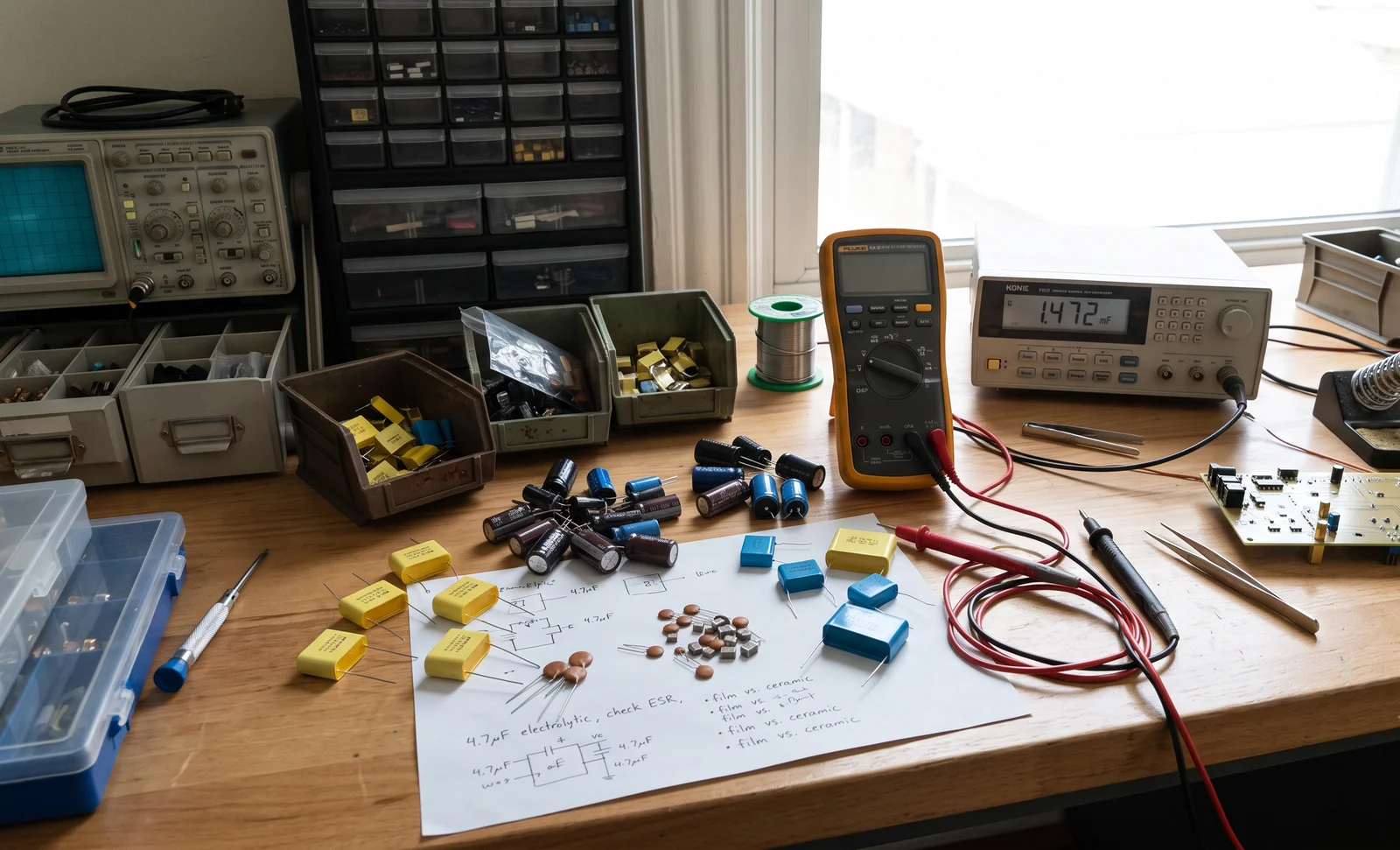
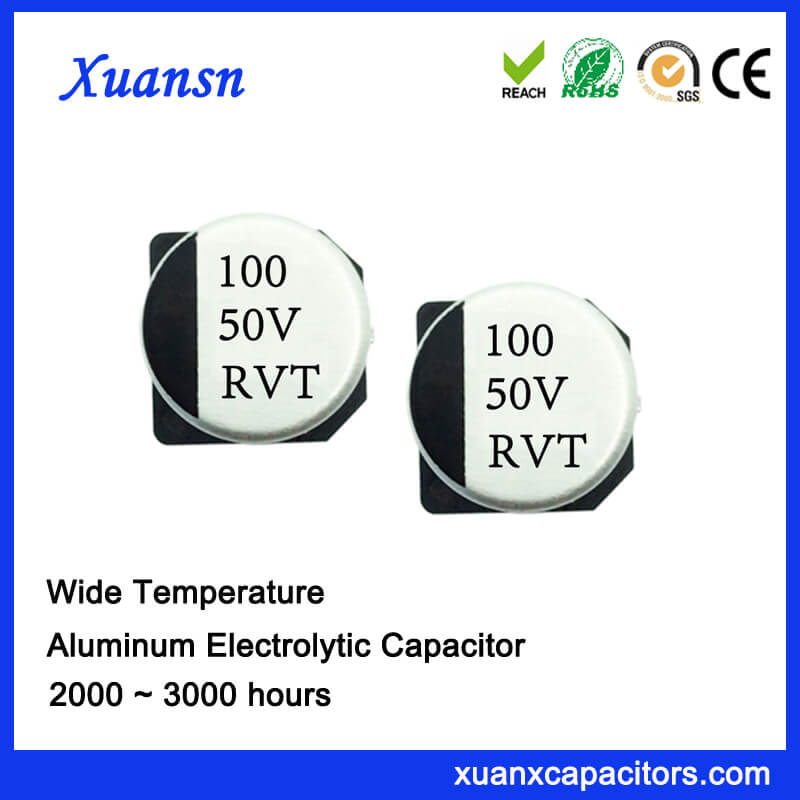
An LCR meter is the standard tool for judging a capacitor on the bench. Measure capacitance and dissipation factor at a defined frequency (100 kHz is common for small ceramics, 120 Hz for electrolytics), and ESR directly. Leakage current needs a bench power supply and a series resistor at rated voltage. Two practical warnings: ESR is frequency-dependent, so a part that looks good at one frequency may not at another, and a capacitor that reads roughly double its rated ESR, high leakage, or a drifted capacitance is usually a capacitor that has aged and is better replaced than argued with. A quick visual on how a capacitor behaves under test is shown in our capacitor testing photo.
What “good” means changes with the application
The same capacitor can be excellent in one circuit and wrong in another, which is why “good” is always a match and never an absolute. In a power supply output stage, good means low ESR and enough bulk capacitance, because the part has to pass sharp current steps without overheating. In a precision timing or filtering circuit, good means low leakage and a stable dielectric — a class 1 ceramic or a film capacitor — where a class 2 ceramic’s capacitance drift under bias would quietly wreck the timing. At high frequency, good means a small package and low ESL, so an 0402 can beat an 0805 even when the capacitance is identical. In a hot enclosure, good means the temperature rating and lifetime hours that keep the part alive for the product’s whole service life. State the application first, then let the measurements follow.
Buying a good capacitor is buying a consistent one
For volume procurement, “good” mostly means consistent. A supplier that ships the same dielectric, the same tolerance, and the same ESR from lot to lot is more valuable than one with a prettier datasheet. When you compare quotes, ask for the dissipation factor and ESR at the operating frequency, not just capacitance and voltage. If you are choosing among dielectric families, our film capacitor and multilayer ceramic capacitor categories list the key specs side by side, and we will quote against your exact tolerance and ESR requirements — send us your circuit conditions and target price.