Capacitor lead times in 2026 have stretched from weeks to months, and on AI-grade MLCC a ten-month quote is no longer unusual. Ordering more will not fix that. The buyers holding their schedules together are the ones who know which lines on the bill of materials have to be locked, commit on those before allocation begins, and have a second source qualified for the rest.
We covered the price side of this cycle in our article on the 2026 capacitor price increase. This one works through the other half, in the order a buyer actually has to deal with it.
Where Lead Time Pressure Actually Sits
Two parts can sit in the same spreadsheet at the same price and carry completely different risk. Separating price from availability is what makes the ranking work, because the lines that deserve a commitment are rarely the ones that cost the most.
| Capacitor family | Lead-time pressure | Substitutability | Lock-in priority |
|---|---|---|---|
| MLCC | Longest. Commodity grades go on allocation first | Often workable on bulk rails, rarely in timing and RF | Highest |
| Aluminum electrolytic | Rising on long-life and high-voltage series | Possible within the family, needs bench checks | High |
| Film | Shorter, but DC-Link grades track EV demand | Limited once the mechanical footprint is fixed | Medium |
| Supercapacitor | The wait sits in qualification, not production | Few qualified sources to swap between | Medium, but start early |
MLCC carries the longest waits. It sits closest to the AI server demand shock, and commodity grades are the first to be cut when capacity is redirected toward higher-margin parts. Aluminum electrolytic capacitors come next, with long-life and high-voltage series hardest to find while general-purpose values stay comparatively easy. Film is firmer on price but shorter on lead time. Supercapacitors behave differently again: the delay usually sits in qualification rather than in production, because fewer suppliers can meet the cell-level requirements for a UPS or hold-up module.
Nobody’s lead time quote survives a demand shift
A supplier quoting sixteen weeks in a tightening market is describing a plan. When demand moves again, that plan moves with it, and the purchase order you are holding does not travel with it. So track what the last three shipments on that part actually took, rather than what the system said they would take.

Which Parts Deserve a Commitment
Most buyers treat “should we lock in?” as one decision for the whole bill of materials. It splits into a per-part decision once you ask three questions.
How much of the part do you consume in a year, and how hard would it be to stop consuming it? How far out is the supplier quoting, and is the part already on allocation? If it goes short, can the design take a qualified substitute without a full requalification cycle?
If a part scores badly on all three, negotiation will not rescue it. The fix belongs in the design, and it is worth telling engineering that early.
| Tier | What it looks like | What to do |
|---|---|---|
| Tier 1 | High annual volume, long or unstable lead time, no drop-in substitute | Commit volume for the year, ask for reserved capacity, keep a buffer sized to real risk |
| Tier 2 | Moderate volume, lead time moving but not yet allocated | Commit partial volume, share a rolling forecast, hold a live second source |
| Tier 3 | Low volume, short lead time, or easily substituted | Buy to demand. Locking here ties up cash and can leave you holding stock you cannot use |

The expensive parts are often the wrong ones to lock
It is tempting to start with the highest-value lines. That instinct usually produces the wrong list. A cheap capacitor appearing a thousand times on one board stops a line just as completely as an expensive one, and it is more likely to be allocated, because commodity grades are exactly what gets squeezed when capacity moves. Sort by exposure rather than unit cost.
What Allocation Actually Means for Your Order
Allocation works off purchase history. When a supplier cannot meet demand, they divide what they have in proportion to what you have bought in the past rather than this quarter’s requirement. A buyer with three years of steady orders keeps a larger share than one who placed the same total volume in a single urgent order.
That changes what good procurement looks like in a shortage. Predictable ordering is worth more than it appears, and it is one of the few levers a buyer still controls once a part goes short.
Why doubling your order works against you
When word of a shortage spreads, the instinct is to order more than you need and cancel later. Everyone does it at once. The shortage then looks worse than it is, the supplier allocates harder, and your purchase history stops reflecting your real usage. If the market softens, you are also sitting on volume you cannot consume. Ordering to forecast, and being visibly disciplined about it, keeps your allocation position defensible.
The Clauses That Make a Lock-In Worth Signing
A long-term agreement is only as useful as its terms. Committing to a volume at a price, with nothing else attached, moves all the risk onto the buyer.
| Clause | What to ask for | Why it matters |
|---|---|---|
| Price protection | A cap, plus a defined trigger for renegotiation | Fixed prices get priced defensively at the start. A cap shares the risk instead of shifting it |
| Volume band | A tolerance around the committed quantity, agreed in writing | Lets you flex with demand without breaching the agreement |
| Capacity reservation | Explicit reserved capacity, separate from the volume commitment | A volume commitment does not guarantee you line time when the fab is full |
| Allocation language | A written definition of how your share is calculated if supply is restricted | Ambiguity here is where buyers lose in a shortage |
| Substitution consent | Pre-agreed freedom to accept a qualified equivalent if the original is unavailable | Turns a line stop into a documented change |
A cap beats a fixed price
Ask a supplier for a fixed twelve-month price in a rising market and they will protect themselves somewhere else, usually in the base price or in delivery priority. A capped price with a stated trigger for review tends to produce a workable number, and it keeps the relationship intact when the market moves again.
When to Change the Design Instead
For the parts that score worst, a contract may be the wrong tool. Revisiting the specification can be quicker than negotiating for something nobody can supply.
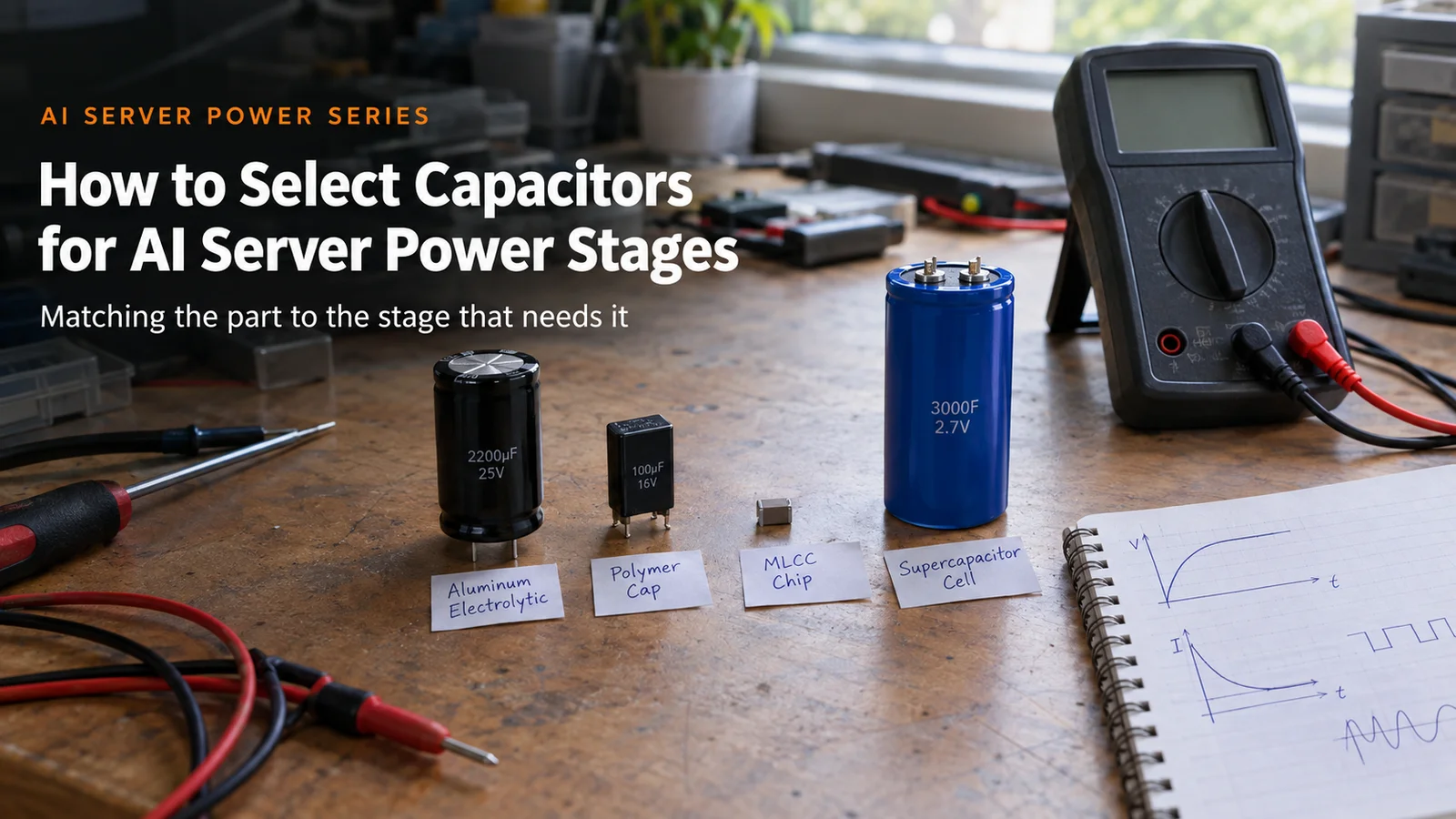
Start with over-specification. A part carrying an automotive-grade rating on an industrial board, or a 125 °C rating where 105 °C will do, is paying for margin the design never uses, and it competes for capacity against buyers who genuinely need that grade. Then look at the type itself. Some designs use ceramic where a polymer or aluminum electrolytic part would work, which puts the BOM on the tightest part of the market for no functional gain. Matching the part to the rail rather than to habit is the exercise, and our selection guide for AI server power stages walks through it.
How long a second source really takes
Longer than most buyers expect. There are samples to run, bench verification at the actual operating conditions, a lifetime check at temperature, and for regulated or automotive programs a full qualification file. A process like that runs across quarters. It also cannot be compressed once a shortage is already underway, which is the argument for starting on the Tier 1 parts while there is still time to do it properly.
If your BOM leans on aluminum electrolytic capacitors for bulk and hold-up, the selection notes for 48 V and 800 V data center rails cover where a second source is realistic and where the electrical requirements leave no room.
A 90-Day Plan to Take Into the Next Negotiation
None of this has to happen in a single push, but the order matters more than the speed.
In the first month, build the ranked list. Sort the BOM into the three tiers, check current lead times against recent shipments rather than quoted figures, and flag every part with no workable substitute. In the second month, open the conversations. Share a rolling forecast that reaches beyond one quarter, ask for a capacity reservation on Tier 1 parts, and put a second source into qualification for anything that scored badly and cannot be re-specified. In the third month, close the agreements with the clause list above in hand, then set a review cadence so the ranking gets revisited as the market moves.
FAQ: Lead Times, Allocation, and Locking In Supply
How long are capacitor lead times in 2026?
It depends on family and grade. AI-grade MLCC is the tightest, with waits that have stretched toward ten months on server demand. Aluminum electrolytic runs longer on long-life and high-voltage series than on general-purpose values, and film is comparatively shorter. Confirm against recent shipments rather than the number in the system, because quotes move faster than they update.
Is the spot market worth the premium?
Sometimes, for a genuine stopgap on a Tier 1 part, but treat it as a last resort. The broker market is where counterfeit and re-marked parts circulate, and the saving on a short delivery can disappear in a failed batch or a recall. If you buy outside the authorized channel, budget for incoming inspection and keep broker stock out of regulated programs unless it comes with full traceability.
Should I lock the whole BOM or just part of it?
Part of it. Committing the entire bill of materials for a year turns a supply problem into an inventory problem, and most designs change enough over twelve months that some of that stock becomes unusable. Commit where lead-time risk and exposure are both real, and stay flexible on the rest.
Can a smaller supplier hold buffer stock for me?
Often yes, and it is worth asking. A supplier with a direct manufacturing line can sometimes hold agreed buffer stock or run scheduled releases against a forecast, which uses your working capital better than carrying the stock yourself. Put the arrangement in writing, including how the buffer is topped up and what happens if demand falls away.
Xuansn has supplied capacitors through previous shortage cycles, so we quote against the specification and volume you actually need rather than a catalog headline. Send over your bill of materials and target price to [email protected], and we will come back with availability, lead time, and a costed substitute where one exists.